
Behavioral Analytics Security 2026: Smart Defense
Why Behavioral Analytics Security Matters for Modern Protection
Behavioral analytics security is a cybersecurity approach that uses machine learning and big data to analyze patterns of activity by users, devices, and applications—establishing what’s considered “normal” behavior and detecting anomalies that could signal potential threats. Unlike traditional rule-based systems that rely on known attack signatures, behavioral analytics proactively identifies suspicious deviations in real-time, helping organizations spot insider threats, advanced persistent threats (APTs), and zero-day exploits before they cause damage.
Key aspects of behavioral analytics security:
- What it monitors: User actions, device behavior, network traffic, application usage, and cloud activity
- How it works: Collects data, builds behavioral baselines, detects anomalies using AI/ML, scores risk levels, and alerts security teams
- Main types: UBA (User Behavior Analytics), UEBA (User and Entity Behavior Analytics), NBA (Network Behavior Analytics)
- Core benefits: Proactive threat detection, reduced false positives, faster incident response, improved compliance
- Best for: Detecting insider threats, APTs, credential misuse, account takeover, and data exfiltration
Traditional security systems struggle with today’s sophisticated threats. Rule-based detection only catches known attack signatures, leaving organizations vulnerable to new attack methods, compromised credentials, and malicious insiders. It’s nearly impossible for security teams to manually spot subtle behavioral changes across thousands of users and devices.
This is where behavioral analytics makes a difference. By establishing a baseline of normal activity for each user, device, and application, it can flag unusual behavior even when there’s no obvious rule violation. For example, it can automatically catch an employee downloading massive files at 3 AM, a service account authenticating from an unfamiliar location, or network traffic to a new domain.
This technology thrives on the massive amounts of data organizations generate today. Using unsupervised machine learning, it continuously learns and adapts, improving its ability to distinguish real threats from harmless anomalies as it processes more data.
For business owners and site managers protecting large or remote properties, this approach offers a smarter layer of security. Whether you’re securing a construction site, healthcare campus, or temporary event space, behavioral analytics can monitor activity patterns across all your connected cameras, access systems, and network devices—alerting you to suspicious behavior before it escalates into a security incident.
I’m Chris Edens, and after years of protecting people in the military and through advanced technology solutions, I’ve seen how behavioral analytics security transforms threat detection from reactive to proactive. At Mobile Vision Technologies, we integrate these intelligent capabilities into our mobile surveillance systems, giving you eyes everywhere with the brain to know what matters.
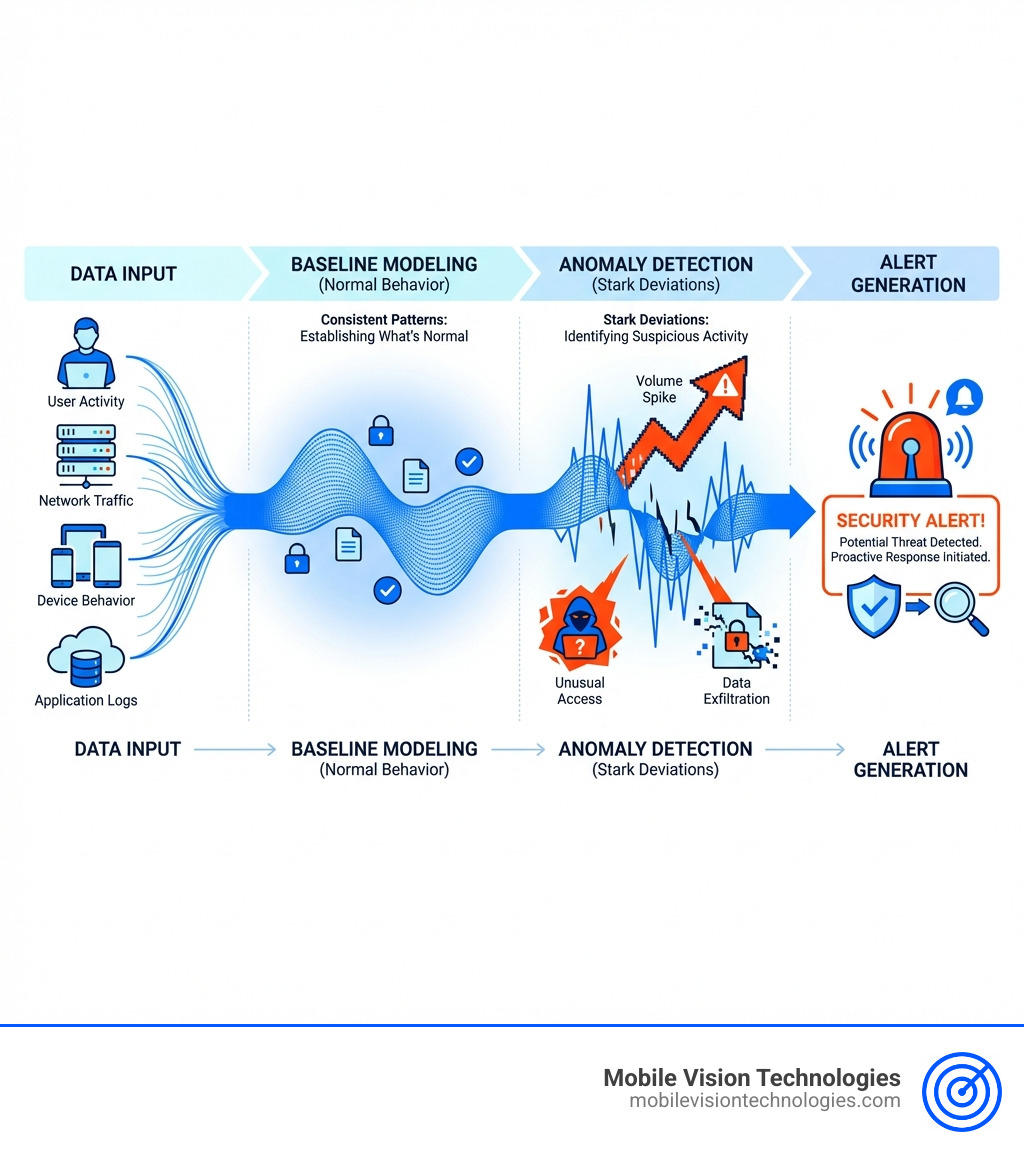
How Behavioral Analytics Works: The Core Engine of Modern Security
At its heart, behavioral analytics security is about understanding patterns. Imagine your organization as a busy city. Everyone has their routines—where they go, when they go, what they carry. Behavioral analytics is like having an incredibly observant city planner who knows everyone’s normal routine, not to spy, but to immediately notice when someone is doing something highly unusual, like trying to climb a building at 3 AM or suddenly carrying a suspiciously large, heavy bag. This proactive vigilance is crucial in today’s complex cyber landscape.

The Core Components of a Behavioral Analytics System
A robust behavioral analytics security system relies on several interdependent components that work together to collect, process, and interpret behavior data:
- Data Collection and Enrichment: The first step is gathering comprehensive data. This includes logs from servers and firewalls, network traffic (the focus of Network Behavior Analytics or NBA), endpoint data from workstations, and SaaS application activity. Contextual data like geolocation and user roles is added to enrich this information, which is vital because behavioral analytics thrives on “big data.”
- Behavioral Baseline Modeling: Once data is collected, the system learns what’s “normal.” This involves establishing a profile of typical activity for each user, device, and application. The system also compares a user’s behavior to their peers. For example, an accountant accessing engineering files is more suspicious if they are the only one doing so. Baselines aren’t static; the system continuously updates its understanding of normal behavior as operations change.
- Anomaly Detection Engines: This is where the magic happens. These engines compare real-time activity against established baselines to identify deviations that could indicate threats. They use a mix of techniques, including statistical thresholds, unsupervised machine learning (e.g., DBSCAN) to find hidden patterns, and supervised models for known threat types. These algorithms are crucial for detecting unknown threats like zero-day attacks. When an anomaly is detected, an alert is sent to security teams.
- Risk Scoring and Prioritization: Not all anomalies are created equal. A single unusual login might be benign, but combined with other suspicious actions, it becomes a high-priority alert. Each anomalous event is given a risk score, which is adjusted based on context like asset sensitivity and user privilege. This helps security analysts focus on the most critical threats.
- Automated vs. Manual Response Actions: Based on the risk score, the system can trigger various responses. These can be automated actions, such as locking an account or blocking an IP for high-confidence threats, or manual investigations for lower-risk anomalies, where alerts are sent to security analysts.
The Role of AI and Machine Learning
Artificial Intelligence (AI) and Machine Learning (ML) are the powerhouses behind modern behavioral analytics security, enabling systems to process data volumes that far exceed human capabilities.
- Unsupervised Learning: Instead of being trained on known malicious patterns, unsupervised algorithms learn what “normal” looks like and then flag anything that deviates significantly. This allows for the detection of novel attacks and advanced persistent threats (APTs) that have no known signatures.
- Supervised Models: Trained on labeled data of known threats, supervised models help classify new activities and refine detection accuracy.
- Big Data Processing: ML algorithms can process petabytes of data, identifying subtle correlations and patterns that would be invisible to human analysts or rule-based systems.
- Pattern Recognition: AI recognizes complex activity patterns, enabling organizations to identify threats and optimize security.
- Reducing False Positives: Through continuous learning and feedback, AI helps reduce false positives. This prevents alert fatigue and allows security teams to focus on genuine threats.
- Real-Time Insights: AI-powered tools provide real-time insights, dashboards, and immediate alerts. As we’ve learned, AI transforms surveillance from passive recorders into proactive guardians, allowing security operations to work smarter and faster. AI analytics turns raw data into actionable intelligence.
Key Types and Use Cases for Behavioral Analytics Security
To effectively combat diverse threats, behavioral analytics security has evolved into several specialized types. Each focuses on a particular aspect of your digital environment, but together, they create a comprehensive, threat-centric approach that allows for proactive threat hunting and rich context enrichment.
Main Types of Behavioral Analytics
- User Behavior Analytics (UBA):
- Focus: Concentrates on analyzing individual user actions to establish their normal patterns.
- What it detects: Abnormal login times, unusual access to sensitive files, or changes in application usage. It’s particularly strong at identifying insider threats or compromised user accounts.
- User and Entity Behavior Analytics (UEBA):
- Focus: An extension of UBA, this broadens the scope to include non-human entities like devices (servers, IoT devices), applications, and service accounts.
- What it detects: UEBA provides more complete threat visibility in modern, complex environments, allowing it to detect threats originating from compromised devices or applications, not just users.
- Network Behavior Analytics (NBA):
- Focus: Specifically monitors network traffic to detect unusual activity.
- What it detects: Unexpected traffic patterns, communication with malicious sites, or large data transfers. NBA is crucial for spotting early signs of advanced persistent threats (APTs) and insider activity.
- Insider Threat Behavior Models (ITBA):
- Focus: A specialized implementation aimed at detecting misuse of legitimate access by trusted insiders. ITBA is a part of UBA that helps organizations identify bad actors they trust.
- What it detects: Combines behavioral signals with contextual data (e.g., role changes) to identify subtle indicators like unusual file access frequency or attempts to bypass standard workflows. This is invaluable for detecting damaging and hard-to-find insider threats.
Behavioral Analytics vs. Traditional Security (SIEM)
Behavioral analytics security offers a dynamic and intelligent layer that complements, rather than replaces, traditional Security Information and Event Management (SIEM) systems.
| Feature | Behavioral Analytics (BA) | Rule-Based SIEM (Traditional) |
|---|---|---|
| Detection Method | Machine learning (ML) and AI to establish baselines and detect deviations/anomalies. Continuously learns and adapts. | Predefined rules, signatures, and correlation logic. Detects known threats and rule violations. |
| Threat Focus | Unknown threats, zero-day attacks, advanced persistent threats (APTs), insider threats, credential misuse, account takeover. | Known malware, policy violations, common attack patterns, compliance reporting. |
| Adaptability | Highly adaptive. Evolves with user behavior and threat landscape. | Static. Requires manual updates for new threats and rules. Less effective against novel attacks. |
| Alert Quality | Lower false positives due to contextual analysis and baseline learning. Prioritizes alerts based on risk. | Higher false positives as it flags any rule violation, regardless of context. Can lead to alert fatigue. |
| Data Source Focus | Comprehensive user, entity, application, and network activity data. | Primarily log data from various security devices and applications. |
Many modern SIEMs now include UEBA modules, creating a powerful combination. This integration allows the SIEM to handle log aggregation and compliance while behavioral analytics provides the intelligence to spot the complex, evolving threats that rule-based systems miss.
Real-World Use Cases in Action
The practical applications of behavioral analytics security are vast and critical for protecting businesses in Memphis and beyond:
- Insider Threat Detection: This is a prime use case. By flagging unusual employee behavior—like an employee logging in from an unfamiliar location late at night or suddenly downloading massive amounts of sensitive data—it can detect malicious actions from within. Specialized models can even correlate behavioral indicators with other data for more context.
- Advanced Persistent Threats (APTs): These stealthy attacks are designed to avoid rule-based detection. Behavioral analytics excels here by identifying deviations from normal behavior, such as a compromised system communicating with an unusual external IP or engaging in lateral movement detection within the network.
- Credential Misuse and Account Takeover: If a user account that typically operates from Memphis suddenly attempts to log in from a foreign country, behavioral analytics will flag it. It detects patterns inconsistent with a legitimate user’s history, preventing credential misuse or account takeover.
- Data Exfiltration Detection: A user suddenly transferring large amounts of data or a system connecting to unusual cloud providers could indicate data exfiltration detection. Behavioral analytics monitors these activities to prevent sensitive information from leaving your organization.
- Physical Security Integration: At Mobile Vision Technologies, we extend behavioral analytics to physical security. Our AI-Powered Video Surveillance systems use similar principles to detect unusual movement patterns. For instance, if someone is loitering near a restricted area of a construction site in Jackson, TN, after hours, our AI can flag this as anomalous, allowing for proactive deterrence and faster response.
Putting It into Practice: Implementation, Challenges, and Best Practices
Implementing behavioral analytics security is a strategic move that significantly strengthens an organization’s defense against sophisticated cyber threats. However, like any advanced technology, it comes with its own set of benefits, challenges, and best practices that we, at Mobile Vision Technologies, guide our clients through.
Key Benefits of Behavioral Analytics
The advantages of adopting a behavioral analytics security approach are profound:
- Proactive Threat Mitigation: The major benefit is the ability to identify a wider range of cyber threats, including insider threats, advanced persistent threats (APTs), and zero-day exploits, before they cause significant damage. By detecting subtle anomalies, we move from reactive defense to proactive interception.
- Reduced Alert Fatigue: Traditional rule-based systems often generate excessive alerts, many of which are harmless (“false positives”). Behavioral analytics security uses ML to prioritize alerts based on actual risk, significantly reducing the noise and allowing security analysts to focus on what truly matters. This saves significant time and money.
- Faster Incident Response: Automated behavioral analytics security systems monitor behaviors in real-time and send alerts as and when an unusual behavior is detected. This immediate notification, coupled with rich contextual information, enables security teams to respond much faster and more effectively to potential incidents.
- Improved Visibility: By analyzing comprehensive user activity data across networks, devices, and applications, behavioral analytics provides deeper and more dynamic insights into your organization’s security posture than traditional monitoring alone. It can reveal unusual patterns such as data exfiltration activities, potential distributed denial-of-service (DDoS) attacks, and insider threat behaviors.
- Compliance Enablement: Behavioral analytics security helps organizations adhere to stringent regulatory requirements like GDPR and HIPAA. By detecting non-compliant user behaviors and providing auditable trails of data access and usage, it offers mechanisms to anonymize sensitive data, enforce data retention and access policies, and demonstrate compliance.
Common Challenges and Limitations
Despite its immense benefits, implementing behavioral analytics security isn’t without its problems:
- High Data Volume and Noise: Behavioral analytics relies on collecting massive amounts of data. This “big data” can overwhelm storage and processing systems, and irrelevant events (“noise”) can make it harder to identify meaningful anomalies.
- False Positives and Alert Fatigue: While generally better than traditional methods, overly sensitive detection thresholds can still produce excessive alerts. This can lead to analysts becoming desensitized to critical events, a phenomenon known as alert fatigue.
- Data Privacy Concerns: Monitoring individual user actions raises legitimate concerns about privacy and regulatory compliance. Organizations must be transparent and meticulous about the kind of data collected, requiring strict controls over what is gathered and how it is used.
- Integration Complexity: Behavioral analytics systems must often integrate with existing detection and response platforms like SIEM, EDR, and SOAR. This can involve complex configuration and interoperability challenges. Our team at Mobile Vision Technologies understands these complexities and offers comprehensive installation and monitoring services to ensure seamless integration and optimal performance.
- Accurate Baseline Building and Maintenance: Establishing what constitutes “normal” behavior requires time and high-quality data. Ongoing changes in operations, user roles, or even seasonal variations can make baselines obsolete without regular updates and retraining.
- Scalability Concerns: Older infrastructure may lack the capacity or compatibility needed to support real-time analytics at scale, potentially requiring upgrades or re-architecture.
Best Practices for Effective Behavioral Analytics Security
To maximize the effectiveness of your behavioral analytics security solution and overcome common challenges, we recommend the following best practices:
- Define Security Objectives and Threat Models: Clearly outline what you aim to protect and the specific threats you’re trying to detect. This helps in configuring the system’s focus and reducing unnecessary monitoring.
- Integrate with Your Broader Detection Stack: A continuous feedback loop—validating alerts against real-world outcomes and fine-tuning models—helps reduce false positives. Integrate behavioral analytics with your SIEM, Security Orchestration, Automation, and Response (SOAR), and Endpoint Detection and Response (EDR) platforms for a unified and more effective security posture.
- Continuously Train and Update Models: Treat behavioral analytics security as a living program, not a one-time setup. Regularly monitor for behavioral drift over time and retrain models quarterly to adapt to evolving threats and changes in user behavior.
- Educate Security Analysts: Train your IT and security personnel on how behavioral analytics works and how to interpret behavior-based alerts. Understanding the context behind an alert is crucial for making informed decisions.
- Adjust Sensitivity Settings Iteratively: Start with a balanced sensitivity and adjust it over time. Overly sensitive settings can lead to alert fatigue, while too low can miss critical threats. Iterate to find the sweet spot for your environment.
- Prioritize Privacy and Compliance: Implement robust privacy controls, including data anonymization and strict access policies, to ensure compliance with regulations like GDPR and HIPAA. Be transparent about data collection practices.
The Future of Behavioral Analytics in Cybersecurity
The cybersecurity landscape is constantly evolving, with threats becoming more sophisticated and pervasive. In this dynamic environment, behavioral analytics security is not just a tool; it’s a foundational element for future defense strategies. We anticipate a future where these systems become even more intelligent, autonomous, and integrated, moving beyond detection to predictive and proactive measures.
Evolving Trends in Analytics
- Deeper Contextualization: Future systems will integrate even more diverse data sources, from HR systems to physical access logs, to build richer, more nuanced behavioral profiles. This deeper context will allow for more accurate threat detection and significantly reduce false positives.
- Cross-Platform Correlation: As organizations accept multi-cloud and hybrid environments, behavioral analytics security will excel at correlating activities across disparate platforms and services, providing a unified view of an entity’s behavior regardless of where it operates.
- Cloud Environment Security: UEBA is already proving effective in cloud environments where traditional tools struggle. Its ability to analyze behavior across cloud-based assets will become even more critical as cloud adoption grows.
- IoT Security: With the proliferation of IoT devices in homes and businesses, behavioral analytics will play a crucial role in monitoring these devices for unusual patterns that could indicate compromise or misuse. Our mobile surveillance systems are already incorporating these advanced analytics to protect physical assets and properties in areas like Memphis and Jackson, TN.
- Predictive Analytics: Moving beyond anomaly detection, future behavioral analytics will leverage AI to predict potential security incidents before they even fully materialize, based on subtle precursor behaviors.
The Rise of Agentic AI in Behavioral Analytics Security
One of the most exciting developments is the emergence of Agentic AI. Agentic AI refers to autonomous AI agents that are able to learn, adapt, and react to situations in real time. This is a game-changer for behavioral analytics security.
- Autonomous Agents: Unlike traditional AI that fulfills specific directives, agentic AI can analyze situations, implement responses, and even learn from those responses without constant human intervention.
- Complex Reasoning: Agentic AI combines several advancements in artificial intelligence to create a technology capable of complex reasoning and autonomous defensive action in real time. This means it can understand intricate attack chains and respond intelligently.
- Real-Time Adaptation: These agents continuously learn and adapt to new threats and evolving normal behaviors, making them incredibly resilient. They can proactively search for cyber threats and build custom defenses against them in real time.
- Exponentially Faster Response: Since it can watch, reason, and act autonomously, agentic AI creates exponentially faster response times. The average human’s attention span focuses on one screen for less than a minute, making it challenging for security teams to monitor everything. Agentic AI can monitor a virtually unlimited number of screens and data streams simultaneously without losing focus, implementing appropriate response measures immediately.
- Proactive Defense: Agentic AI transforms security from reactive to truly proactive. It can verify alerts, take on repetitive tasks, and augment analysis for security personnel, enhancing situational awareness by compiling and analyzing data from multiple sources. This quick, intelligent response offered by agentic AI can seriously improve the safety and security of your company and your people.
Frequently Asked Questions about Behavioral Analytics Security
We often encounter common questions about behavioral analytics security from business owners and IT professionals. Here are some of the most frequent ones:
What is the main difference between UBA and UEBA?
The primary distinction lies in their scope. User Behavior Analytics (UBA) focuses exclusively on analyzing the activities of individual human users within a system. It builds profiles of their typical actions—login times, file access, application usage—to detect deviations. User and Entity Behavior Analytics (UEBA), on the other hand, significantly expands this focus. UEBA includes not only human users but also non-human “entities” such as devices (servers, routers, IoT devices), applications, and even service accounts. This broader scope provides more comprehensive visibility into modern, complex environments, making UEBA more effective at detecting threats that might originate from compromised devices or automated processes, not just human users.
How does behavioral analytics handle user privacy?
User privacy is a critical consideration for behavioral analytics security. Responsible implementations address this through several mechanisms:
- Data Anonymization: Sensitive identifying information about users can be anonymized or pseudonymized before analysis, ensuring that the focus is on behavioral patterns rather than individual identities.
- Strict Access Policies: Access to raw behavioral data is tightly controlled and limited to authorized security personnel, often with role-based access controls.
- Purpose Limitation: Data collection and analysis are strictly confined to security purposes, preventing its misuse for other functions without explicit consent.
- Compliance Controls: Systems are designed to meet regulatory requirements like GDPR (General Data Protection Regulation) and HIPAA (Health Insurance Portability and Accountability Act), providing auditable trails of data access and usage.
The goal is to monitor for security-relevant anomalies while minimizing the collection and retention of personally identifiable information.
Can behavioral analytics replace my SIEM?
No, behavioral analytics security is not a replacement for a Security Information and Event Management (SIEM) system; rather, it is a powerful complement. A SIEM is designed to aggregate and correlate log data from various security devices and applications across your IT infrastructure, primarily using predefined rules and signatures for detection and compliance reporting. Behavioral analytics, particularly UEBA, improves the SIEM’s capabilities by applying machine learning to detect anomalies and unknown threats that rule-based systems would miss. Many modern SIEM platforms now integrate UEBA modules directly, creating a layered defense that combines the SIEM’s broad visibility and historical data with the proactive, intelligent threat detection of behavioral analytics. Together, they provide a much stronger and more adaptive security posture.
Conclusion: Secure Your Future with Intelligent Detection
In an era where cyber threats are constantly evolving and traditional security measures are often outmaneuvered, embracing behavioral analytics security isn’t just an option—it’s a necessity. This intelligent approach moves beyond static rules and signatures, leveraging the power of AI and machine learning to understand what’s normal in your unique operational environment and, crucially, to spot what’s not.
By detecting subtle anomalies in user, device, and network behavior, we can proactively identify insider threats, advanced persistent threats, and zero-day exploits before they escalate into costly breaches. This leads to reduced alert fatigue for your security teams, faster incident response times, and a significantly stronger overall security posture. For businesses across Memphis, Bartlett, Southaven, and surrounding areas, this means safeguarding your valuable data, ensuring operational continuity, and protecting your reputation.
At Mobile Vision Technologies, we are committed to bringing these cutting-edge capabilities to your doorstep. Our expertise in advanced IoT and traditional security solutions, combined with the power of behavioral analytics security, ensures that you have the most intelligent and proactive defense possible. Don’t let your security strategy fall behind the evolving threat landscape.
Learn more about our AI-Powered Video Surveillance solutions and find how we can help you secure your future with intelligent detection.