
Behavior based ids: Smart Defense 2026
Why Traditional Security Can’t Stop Today’s Threats
Behavior based ids (Intrusion Detection Systems) represent a modern approach to cybersecurity that catches threats by analyzing patterns and actions rather than relying on known attack signatures. Here’s what you need to know:
What is Behavior-Based IDS?
- Detection Method: Monitors network traffic, user actions, and system processes to establish a baseline of “normal” behavior
- How It Works: Flags deviations from established patterns as potential threats
- Key Advantage: Detects unknown threats, including zero-day attacks, that signature-based systems miss
- Primary Use: Best for organizations facing evolving threats, insider risks, or protecting high-value assets
Compared to Traditional IDS:
- Signature-based IDS = Knows what threats look like (like a fingerprint database)
- Behavior-based IDS = Knows what threats act like (by spotting unusual behavior)
The cybersecurity landscape has fundamentally changed. With 43% of cyberattacks targeting small businesses and threats becoming more sophisticated daily, relying solely on known attack signatures is like locking your door but leaving the windows open.
Traditional signature-based intrusion detection systems work well against yesterday’s threats. They compare incoming traffic against a database of known malware patterns—much like matching fingerprints at a crime scene. But what happens when attackers use brand-new methods? When hackers mutate their code to avoid detection? Or when the threat comes from inside your network, behaving almost normally?
This is where behavior based ids changes the game.
Instead of asking “Does this match a known threat?”, behavior-based systems ask “Does this act suspiciously?” They establish what normal looks like for your network—typical login times, usual data transfer volumes, regular communication patterns—and then watch for anything that deviates. It’s proactive defense rather than reactive response.
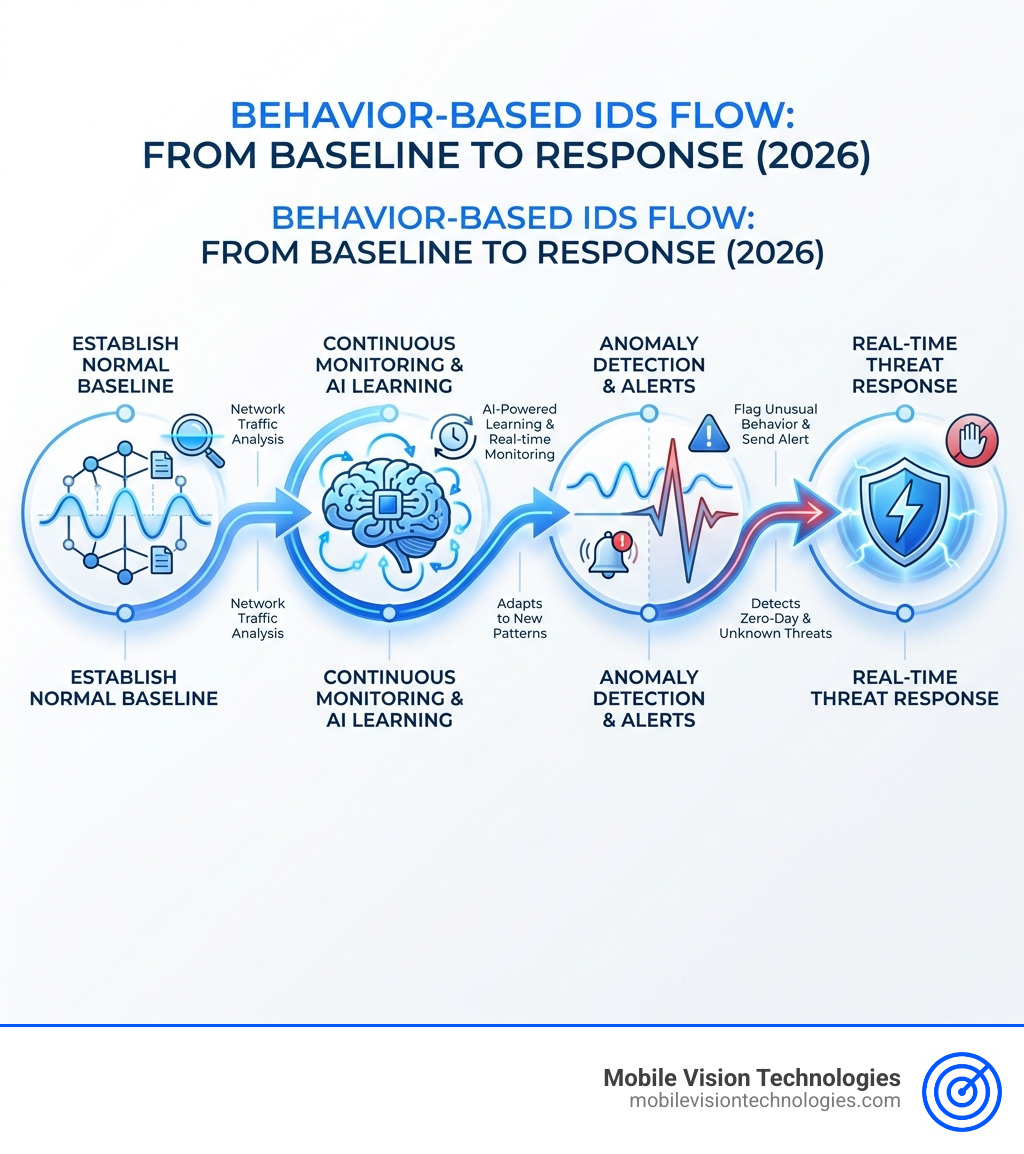
The technology relies on statistical analysis and machine learning to continuously learn and adapt. During an initial learning period, the system profiles your network’s everyday activity. From there, it monitors in real-time, comparing current behavior against established baselines. When something doesn’t fit the pattern—unusual memory usage, unexpected file modifications, communication with suspicious servers—it raises the alarm.
For organizations managing critical infrastructure, high-value assets, or remote facilities, this approach offers crucial advantages. It catches zero-day exploits before patches exist. It identifies insider threats that legitimate credentials can’t hide. It detects sophisticated attacks that unfold slowly across multiple stages.
I’m Chris Edens, and throughout my career protecting people and assets—from military service to implementing advanced security technologies—I’ve seen how behavior based ids strengthens defense strategies, especially for facilities that need intelligent, adaptive surveillance. That real-world experience informs everything we do at Mobile Vision Technologies.
The Proactive Shift: Behavior-Based vs. Signature-Based IDS
When we talk about Intrusion Detection Systems (IDS), it’s often a conversation about two main philosophies: signature-based and behavior-based. Think of it like this: are we looking for a known face in a crowd, or are we looking for someone acting suspiciously?

How Signature-Based IDS Works
Signature-based IDS is the traditional workhorse of cybersecurity. It operates on a simple principle: identify threats by comparing network traffic or system activity against a database of known attack patterns, or “signatures.” Each signature is like a unique digital fingerprint belonging to a specific piece of malware, a known exploit, or a malicious sequence of commands.
When data flows through the network or activity occurs on a host, the signature-based IDS carefully scans it, searching for a match. If it finds a pattern that corresponds to an entry in its signature database, it flags it as a threat and generates an alert. This method is incredibly effective at detecting previously identified attacks quickly and with high accuracy. For instance, if a new variant of a common virus emerges, and its signature is added to the database, the system can immediately recognize and block it.
However, this reliance on known patterns is also its greatest limitation. Signature-based systems are excellent at catching “the usual suspects”—threats we’ve seen before and have documented. But what about the unusual suspects? The brand-new attacks, the never-before-seen malware, or the clever hackers who mutate their code just enough to slip past known fingerprints? These are what we call zero-day vulnerabilities or zero-day attacks, and signature-based IDS often falls short in detecting them because there’s no pre-existing signature to match. It’s like trying to find a criminal you’ve never seen a picture of—you simply don’t know what you’re looking for.
How Behavior-Based IDS Works
This is where behavior based ids steps in, offering a more adaptive and proactive defense. Instead of focusing on what an attack looks like, it focuses on how an attack behaves. It operates on the premise that even if an attack is new and unknown, its actions will likely deviate from what is considered normal or acceptable within your network.
The process begins with a crucial baselining period. During this time, the behavior based ids system carefully observes and learns the typical activities of users, applications, and network devices. This involves analyzing patterns of network traffic, user login times, data transfer volumes, typical communication endpoints, system process behaviors, and much more. It constructs a comprehensive profile of “normal” behavior for your specific environment.
Once this baseline is established, the system continuously monitors ongoing activity. It employs sophisticated mathematical and statistical algorithms, often powered by machine learning and artificial intelligence, to compare current events against the learned baseline. If an activity deviates significantly from these established patterns—for example, a user attempting to access a server they’ve never touched before, an unusual spike in outbound data, or a system process exhibiting abnormal memory usage—the system identifies it as an anomaly and raises a flag.
The key advantage here is its ability to detect new, unknown, or polymorphic attacks, including zero-day exploits. Because it doesn’t rely on pre-existing signatures, it can identify threats that no one has seen before, simply by recognizing their suspicious actions. This proactive approach leads to lower false negatives for new attacks, meaning fewer novel threats slip through the cracks. It’s about understanding the subtle cues of malicious intent, rather than just matching a known blueprint.
Key Differences at a Glance
To summarize the core distinctions between these two critical IDS approaches, let’s look at a quick comparison:
| Feature | Signature-Based IDS | Behavior-Based IDS |
|---|---|---|
| Detection Method | Compares activity to known attack patterns/signatures | Analyzes deviations from established “normal” behavior |
| Ability to Detect New Threats | Limited; struggles with zero-day attacks | High; effective against zero-day, polymorphic, and unknown threats |
| False Positives | Generally low for known threats | Can be higher initially during baselining, but improves with learning and tuning |
| Maintenance | Requires constant signature database updates | Requires continuous learning, baseline adjustments, and algorithm tuning |
| Primary Use Case | Detecting common, well-known attacks | Detecting novel, sophisticated, and internal threats |
How It Works: The Core Mechanisms of Behavior-Based IDS
Understanding the “what” of behavior based ids is just the beginning. The real magic lies in the “how.” These systems aren’t just guessing; they employ intricate mechanisms to accurately identify deviations from the norm. It’s a bit like a highly trained detective observing subtle changes in a suspect’s routine.

Establishing the “Normal” Baseline
The foundation of any effective behavior based ids is its ability to accurately define “normal.” This isn’t a one-size-fits-all definition; it’s a unique profile built specifically for your organization’s digital environment, whether that’s a small business in Memphis, TN, or a large industrial complex in Southaven, MS.
During the initial setup and learning phase, the system diligently observes and profiles various aspects of your network and system activity. This includes:
- Network traffic profiling: What are the typical volumes, protocols, and communication endpoints? Which applications communicate with which servers? What does healthy inbound and outbound traffic look like?
- User activity monitoring: What are the usual login times and locations for specific users? Which files and applications do they typically access? What is their normal typing cadence or mouse movement patterns? As discussed in About Behavior Detection, these systems analyze patterns of user behavior to create profiles of typical activity based on previous actions.
- System processes: What are the normal CPU and memory usage patterns for servers and workstations? Which processes typically run at what times? What kind of file system changes are routine?
- Communication patterns: Which internal systems communicate with each other, and how often? Which external IP addresses are regularly accessed?
The importance of establishing an accurate baseline cannot be overstated. A solid, comprehensive profile of regular traffic is absolutely crucial to circumventing false positives. If the system doesn’t truly understand “normal,” it will flag legitimate activities as suspicious, leading to alert fatigue and undermining trust in the system. We ensure that our systems, whether deployed in a warehouse in Lakeland, TN, or a construction site in Jackson, TN, undergo a thorough baselining period to accurately define expected patterns.
The Role of AI and Machine Learning
The sheer volume and complexity of data involved in profiling a network make manual analysis impossible. This is where artificial intelligence (AI) and machine learning (ML) become indispensable. They are the brains behind modern behavior based ids.
These advanced algorithms continuously analyze the vast streams of behavioral data, looking for patterns that humans would miss. They learn what’s normal by identifying statistical regularities and relationships within the data. For example, an ML model might learn that a specific server typically initiates connections to only two other internal servers and never communicates with external IP addresses. If it suddenly tries to connect to a dozen new external IPs, the ML model can immediately identify this as an anomaly.
Machine learning enables:
- Pattern recognition: Identifying subtle, complex patterns in behavior that indicate a deviation from the norm.
- Continuous learning: The system isn’t static. It adapts as your network evolves, learning new “normal” behaviors and refining its understanding over time. This “learn-as-you-go” approach helps it distinguish between safe new behaviors and truly unsafe ones.
- Anomaly scoring: Rather than just a binary “threat/no threat,” many systems assign a risk score to anomalous activities, helping security teams prioritize their response.
- Reducing false positives: Through continuous learning and sophisticated algorithms, the system becomes more intelligent, weighing the harmfulness of an activity against its baseline for more accurate predictions and reducing the likelihood of flagging legitimate activities.
At Mobile Vision Technologies, our AI-Powered Video Surveillance solutions leverage similar AI and ML principles to analyze visual data, demonstrating our commitment to cutting-edge, intelligent security.
Real-Time Monitoring and Alerting
Once the baseline is set and the AI/ML models are actively learning, behavior based ids shifts into real-time monitoring mode. This continuous analysis is vital for a rapid response to potential threats.
The system constantly compares ongoing activities—network sessions, file access, process execution—against the established baselines and learned patterns. Any significant deviation triggers an immediate alert. This instantaneous notification is crucial because, as we know, every second counts when dealing with a cyberattack.
Real-time monitoring and alerting allow security teams to:
- Prioritize threats: With detailed information about the anomalous behavior, teams can quickly assess the severity and potential impact of an alert.
- Expedite incident response: Early detection means earlier intervention, potentially stopping an attack before it causes significant damage. This proactive threat hunting is an invaluable feature.
- Circumvent possible attacks: By catching suspicious activity as it happens, administrators have the time to investigate, isolate, and mitigate the threat before it fully materializes, such as preparing for and mitigating a denial-of-service attack.
For our clients, especially those with mobile surveillance systems in places like Memphis, TN, or Germantown, TN, the ability for the platform to support real-time updates is non-negotiable. This ensures that security personnel are always informed and can respond swiftly to protect property and ensure customer safety.
Key Advantages and Practical Challenges
Adopting behavior based ids is a significant step forward in cybersecurity, offering powerful advantages, but it’s also important to be aware of the practical considerations and challenges that come with this advanced technology.
Primary Benefits: Catching the Unseen
The greatest strength of behavior based ids lies in its ability to detect threats that traditional signature-based systems simply cannot.
- Zero-day attacks: These are exploits that target vulnerabilities unknown to the software vendor, meaning there’s no patch and no signature available. Behavior based ids excels here because it doesn’t need a signature; it spots the unusual behavior of the exploit as it tries to compromise your systems. This is a critical capability in today’s threat landscape, where attackers are constantly developing new tactics.
- Advanced Persistent Threats (APTs): APTs are stealthy, long-term attacks often carried out by sophisticated adversaries. They typically involve multiple stages and aim to remain undetected for extended periods. Behavior based ids is adept at identifying the subtle, multi-stage deviations that characterize APTs, such as unusual lateral movement within the network or data exfiltration attempts.
- Insider threats: Whether malicious or accidental, insider threats are notoriously difficult to detect with signature-based systems because they often involve legitimate credentials. However, an insider’s actions will almost certainly deviate from their established normal behavior—accessing unusual files, logging in at strange hours, or attempting to transfer large amounts of sensitive data. Behavior based ids can flag these anomalies, helping to detect insider threats or compromised user accounts.
- Polymorphic malware: This type of malware constantly changes its code to avoid detection by signature-based scanners. By focusing on behavior rather than static code, behavior based ids can identify polymorphic threats as they execute their malicious actions.
- Detecting complex attacks: Many modern attacks involve a sequence of unusual events or multiple stages. Behavior based ids is specifically designed to track actions and sequences of events, making it ideal for detecting complex attacks that unfold over time, including sophisticated denial-of-service (DoS) attacks that might involve unusual network traffic patterns.
Potential Challenges of behavior based ids
While the benefits are compelling, it’s also important to approach behavior based ids with a realistic understanding of its challenges.
- Initial learning period: As we discussed, establishing an accurate baseline takes time and careful observation. During this initial learning phase, the system might generate more alerts as it refines its understanding of “normal.” This period requires patience and active tuning from your security team.
- False positives: Despite the intelligence of AI and ML, behavior based ids can still generate false positives, where legitimate activity is incorrectly flagged as malicious. This is particularly true if the baseline isn’t robust or if there are significant, unannounced changes to your network environment. Alert fatigue can become a real problem if not managed effectively. It’s an ongoing effort to balance sensitivity with accuracy.
- Baselining complexity: Defining “normal” behavior for a dynamic, complex network with thousands of users and devices is no small feat. Factors like seasonal changes, new applications, or major system updates can all shift the baseline, requiring constant recalibration and careful management to avoid both false positives and false negatives.
- Encrypted traffic analysis: A significant portion of modern network traffic is encrypted. While this is great for privacy, it presents a challenge for behavior based ids that needs to inspect packet content. While some systems can analyze metadata or traffic flow patterns without decrypting the payload, full visibility can be hampered.
- Resource intensity: Running sophisticated AI and ML algorithms on vast amounts of real-time data requires significant computational resources. Implementing and maintaining a behavior based ids can be more resource-intensive than a traditional signature-based system, both in terms of hardware and the skilled personnel needed for configuration and analysis.
Implementation and Best Use Cases for behavior based ids
Implementing a behavior based ids is a strategic investment that pays dividends in improved security, especially for organizations with specific needs. It’s not just about installing software; it’s about integrating a smart, adaptive layer into your overall security posture.
Who Benefits Most?
While any organization can benefit from the advanced threat detection capabilities of behavior based ids, certain scenarios and types of organizations find it particularly beneficial:
- High-value asset protection: Organizations that possess critical intellectual property, sensitive customer data, or vital operational systems—like financial institutions or government contractors—need the most robust defense against sophisticated attacks. Behavior based ids offers a critical layer of protection for these prized assets.
- Critical infrastructure: Utilities, transportation networks, and other critical infrastructure sectors are prime targets for cyberattacks that could have devastating real-world consequences. The proactive, zero-day detection of behavior based ids is essential for maintaining operational integrity.
- Financial institutions: Facing constant threats of fraud, account takeovers, and data breaches, financial institutions benefit immensely from behavior based ids. It can detect unusual transaction patterns, anomalous login behaviors (like signing in from a new location or device), and other subtle indicators of fraud that traditional methods might miss.
- Healthcare facilities: With a constant flow of patients, visitors, and staff, healthcare environments in places like Bartlett, TN, or Olive Branch, MS, are complex. They also hold highly sensitive personal health information. Behavior based ids can help detect unauthorized access and protect patient data, as well as monitor for insider threats, a concern in any environment with high-value data.
- Large enterprises: Networks with high traffic volumes and diverse user bases often have complex attack surfaces. Behavior based ids is particularly critical for these environments, as it can scale to monitor vast amounts of data and identify subtle anomalies across a broad range of activities.
- Organizations with remote and distributed workforces: As more employees work remotely, traditional perimeter security becomes less effective. Behavior based ids can monitor individual user behavior regardless of location, helping to identify compromised accounts or insider threats.
- Facilities with extensive physical assets: For businesses operating large physical sites, like warehouses or industrial plants, protecting valuable inventory and infrastructure is paramount. Our Warehouse Security Systems & Industrial Mobile Surveillance solutions, for example, can be improved by behavior based ids to detect unusual access patterns or activity that could signal theft or tampering.
Integrating with Your Existing Security Stack
No single security solution is a silver bullet. The true strength of behavior based ids comes from its ability to integrate seamlessly with and complement your existing security infrastructure, forming a layered defense strategy.
- Layered defense: Think of your security as an onion, with multiple layers of protection. Behavior based ids adds a crucial inner layer, catching threats that may have bypassed outer defenses like firewalls.
- Firewall synergy: A firewall is your first line of defense, blocking known bad traffic. An IDS, whether signature-based or behavior-based, acts as a second layer, monitoring what gets through the firewall. They work in tandem: the firewall keeps out the obvious threats, while the IDS watches for anything suspicious that makes it past.
- Antivirus complement: Traditional antivirus software primarily focuses on detecting and removing known malware files. Behavior based ids complements this by observing the actions of software, even if the file itself isn’t recognized as malicious. This is particularly effective against new or polymorphic malware variants.
- SIEM integration: Security Information and Event Management (SIEM) systems centralize security alerts and logs from all your security tools. Integrating behavior based ids alerts into your SIEM provides a holistic view of your security posture, allowing for better correlation of events and faster incident response.
- Creating a holistic security posture: By combining behavior based ids with other measures like endpoint detection and response (EDR), network segmentation, and regular software updates, you build a comprehensive defense. Our Alarm & Intrusion Detection services, for instance, are designed to integrate various technologies to provide full-spectrum protection.
Key Considerations for Configuration
Implementing behavior based ids effectively requires careful planning and ongoing management. As we know from our experience navigating IDS systems, the devil is in the details.
- Defining scope: Clearly determine what aspects of your network and systems the IDS will monitor. Will it be network-wide, host-based, or focused on specific high-value assets? This helps manage resources and focus detection efforts.
- Tuning sensitivity: This is a crucial balancing act. Too sensitive, and you’ll be flooded with false positives. Not sensitive enough, and you might miss real threats. Regular tuning, based on your organization’s specific risk profile and operational needs, is essential.
- Regular baseline reviews: Your network is not static. New applications are deployed, user behaviors change, and business processes evolve. The baseline of “normal” behavior needs to be reviewed and adjusted periodically to remain accurate and effective.
- Staff training: Your security team needs to understand how the behavior based ids works, how to interpret its alerts, and how to respond effectively. Training empowers employees to spot suspicious behavior and understand security policies, contributing to a safer environment.
- Policy creation: Develop clear policies for how alerts will be handled, who is responsible for investigation, and what steps will be taken for different types of detected anomalies. This ensures a consistent and efficient response to security incidents.
For our Mobile Vision Technologies clients, whether it’s for construction site surveillance in Memphis, TN or law enforcement mobile surveillance across the United States, we emphasize these considerations to maximize the effectiveness of their intrusion detection systems.
Conclusion: Adopting a Smarter, More Adaptive Defense
When cyber threats are constantly evolving, relying solely on yesterday’s defenses is no longer an option. The shift from reactive, signature-based security to proactive, behavior based ids marks a pivotal evolution in cybersecurity. We’ve seen how this adaptive approach excels at detecting the unseen—zero-day attacks, sophisticated APTs, and insidious insider threats—by focusing on the subtle deviations in behavior that betray malicious intent.
The benefits are clear: a more robust defense against novel threats, improved real-time monitoring and response capabilities, and a deeper understanding of your network’s true security posture. While challenges like initial baselining and managing false positives exist, they are outweighed by the critical ability to protect high-value assets and ensure continuous operation in the face of an increasingly hostile digital landscape.
At Mobile Vision Technologies, we believe in providing flexible, full-service protection that combines advanced IoT expertise with traditional security experience. This means offering intelligent mobile surveillance systems and intrusion detection solutions that are not only powerful but also adaptive. Just as our mobile surveillance units provide real-time property and customer safety, our approach to intrusion detection ensures your digital assets are equally protected by understanding the “habits” of threats.
As the future of cybersecurity leans heavily towards adaptive and intelligent systems, embracing behavior based ids is not just an upgrade; it’s a necessity. It’s about moving beyond simply knowing what threats look like and instead understanding what they act like.
Ready to secure your operations with a smarter, more adaptive defense? Learn more about our advanced Alarm & Intrusion Detection services and how we can tailor solutions for your needs.