
Predictive security analytics: Master 2026 Threats
The Future of Security: Understanding Predictive Analytics
Predictive security analytics is a cutting-edge approach that transforms how organizations defend against cyber threats. Instead of just reacting to attacks, it helps you foresee and prevent them.
Here’s what it means:
- Proactive Defense: Moves beyond traditional reactive security measures.
- Data-Driven: Uses historical data, machine learning, and AI.
- Pattern Recognition: Identifies hidden patterns and unusual activities.
- Threat Anticipation: Predicts potential security incidents before they happen.
- Improved Response: Enables faster, more informed security actions.
In today’s digital world, cybercriminals are constantly finding new ways to attack. The speed and veracity of targeted cyberattacks are outpacing defenders. This creates a critical need for a new way to protect assets and information.
Traditional security tools often detect threats only after damage has begun. They rely on recognizing known threats. But with predictive security analytics, you can look ahead. This technology helps you spot warning signs and make security decisions based on likely future events, not just past ones. It’s about having a crystal ball for your security.
Chris has been protecting people since he joined the army. Today, he uses technology and forward-thinking to protect people, especially leveraging predictive security analytics in mobile surveillance solutions.
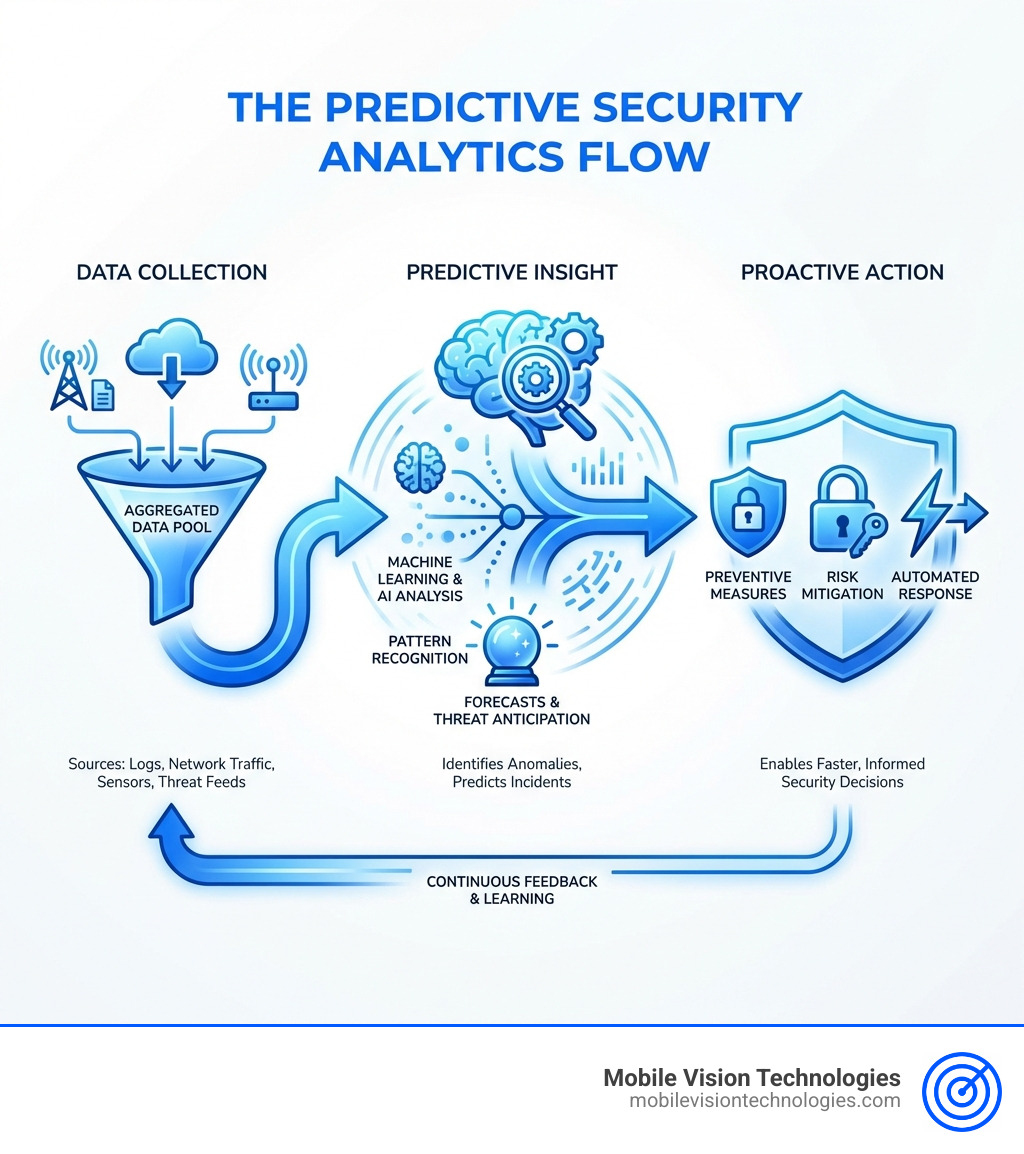
From Reactive to Proactive: The Mechanics of Predictive Security
Gone are the days when security was just about building taller walls around our digital and physical assets. We’ve learned that threats evolve, adapting to our defenses, making a reactive stance increasingly vulnerable. This is where predictive security analytics steps in, offering a fundamental shift from merely responding to proactively anticipating. It’s the core engine that allows us to move from “what happened?” to “what’s going to happen?”

The Role of Data: The Fuel for Foresight
At the heart of any predictive system lies data – vast quantities of it. Think of data as the fuel that powers our security crystal ball. Without rich, diverse, and high-quality data, even the most sophisticated analytics engine would sputter. We continuously ingest data from various sources to paint a comprehensive picture of our environment.
These sources include:
- System Logs: Every action on a computer system, from logins to file access, leaves a trace. Analyzing these logs helps us understand normal behavior and spot deviations.
- Network Traffic: The flow of data across our networks provides crucial insights into communication patterns. Anomalies here can signal anything from malware to unauthorized data transfer.
- User Behavior Data: Our employees, visitors, and even automated systems exhibit patterns. Tracking user activity helps us identify unusual access patterns, excessive data downloads, or logins from multiple locations, which could indicate an insider threat.
- IoT Sensor Data: In our physical security solutions, data from intelligent mobile surveillance systems, camera trailers, and intrusion detection sensors are invaluable. This includes video analytics data, motion sensors, and environmental data.
- Access Control Systems: Records from who enters and exits specific areas, and when, provide another layer of behavioral data to analyze.
- External Threat Intelligence: We don’t operate in a vacuum. Feeds from global attack trends, known vulnerabilities, and emerging threats provide crucial context for our internal data.
The challenge isn’t just collecting this data; it’s aggregating it effectively. We need to centralize logs, network traffic, endpoint data, and third-party intelligence into platforms that can then process and correlate this information. This aggregation is critical because a single data point might seem benign, but when correlated with others, it could reveal a looming threat. We also recognize that the quality of this input data is paramount; insufficient or erroneous data can lead to skewed predictions.
Core Techniques in Predictive Security Analytics
Once we have our data fuel, we employ advanced techniques to turn it into actionable foresight. This is where the magic of predictive security analytics truly happens, leveraging the power of artificial intelligence and machine learning.
- Machine Learning (ML): This is the backbone of our predictive capabilities. We use both supervised and unsupervised learning to teach our systems.
- Supervised Learning: Here, we feed the system labeled data (e.g., “this is a normal login,” “this is a known attack”). The system learns from these examples to identify similar patterns in new, unlabeled data.
- Unsupervised Learning: This is like giving the system a massive puzzle without a picture on the box. It finds hidden structures and patterns in unlabeled data, which is excellent for spotting novel attacks or anomalies we haven’t seen before.
- Anomaly Detection: This technique is all about spotting the “odd one out.” Our systems learn what constitutes “normal” behavior across all data sources. When something deviates significantly from this baseline – perhaps a server suddenly accessing unusual files or an employee logging in at 3 AM from an unfamiliar IP address – it’s flagged as an anomaly. AI is particularly good at distinguishing between a security threat and benign movements, reducing false alarms.
- Behavioral Analytics: A specialized form of anomaly detection, behavioral analytics focuses on user and entity behavior. User and Entity Behavior Analytics (UEBA) is a primary means to detect nefarious activity by internal actors. It gathers data from many sources to identify patterns that indicate a security threat due to anomalous activity. This is crucial for detecting insider threats, where malicious actors already have legitimate access.
- Time Series Models: Many security events occur over time, exhibiting trends, seasonality, or cyclical behavior. Time series models, such as Autoregressive (AR), Moving Average (MA), ARMA, and ARIMA models, are common techniques we use to forecast future events based on historical time-stamped data. For example, we can use these models to estimate the number of attacks in the future or predict when a specific type of incident is most likely to occur. This helps us prepare for imminent threats. You can dig deeper into these technical methods in academic research on predictive methods in cyber defense: Current experience and research challenges.
- Statistical Algorithms: Beyond ML, traditional statistical algorithms like regression analysis and hypothesis testing play a vital role. They help us understand relationships between different data points and validate our predictions with measurable confidence.
By combining these sophisticated techniques, we transform raw data into a powerful tool for foresight, allowing us to anticipate and prepare for security incidents rather than merely reacting to them.
The Proactive Advantage: Key Benefits of Predictive Security Analytics
Adopting a predictive security analytics model isn’t just about sounding technologically advanced; it delivers tangible, measurable benefits that directly impact our bottom line and our ability to protect our people and property. This is the “why” behind our shift towards foresight.
Improved Threat Detection and Rapid Response
One of the most compelling advantages of predictive analytics is its ability to significantly improve our threat detection capabilities and accelerate our response times.
- Early Threat Detection: Imagine knowing an attack is coming before it even fully materializes. Organizations using predictive threat analytics report detecting attacks up to 40% faster than those relying solely on traditional monitoring tools. This early warning system allows us to identify potential threats and facilitate proactive security measures. It’s the difference between catching a fire when it’s a spark versus when it’s a raging inferno.
- Reduced False Positives: Traditional security systems often generate a deluge of alerts, many of which turn out to be harmless (false positives). This “alert fatigue” can overwhelm security teams. Our AI-powered analytics are adept at distinguishing between a genuine security threat and benign movements (like an animal triggering a motion sensor or a weather change). This context-aware insight significantly lowers the false positive rate, allowing our teams to focus on real threats.
- Prioritizing High-Risk Alerts: Not all threats are created equal. Predictive analytics helps us score alerts based on their likelihood and potential impact. This means our security personnel aren’t chasing every shadow but are directed to the most critical risks, enabling more efficient and effective intervention.
- Proactive Mitigation: With early detection and prioritized alerts, we can implement proactive measures to mitigate potential hazards before they escalate. This includes deploying additional security, patching vulnerabilities, or enacting specific Alarm Intrusion Detection protocols based on predicted risk.
Optimized Security Operations and Resource Allocation
Beyond threat detection, predictive security analytics streamlines our entire security operation, making it more efficient and cost-effective.

- Resource Optimization: We understand that resources, both human and technological, are precious. Predictive tools help us optimize limited resources. By forecasting high-risk areas or times, we can strategically deploy guards, position cameras, or allocate mobile surveillance units where they are most needed. This isn’t just about saving money; it’s about making every resource count.
- Manpower Optimization: Our security teams are highly skilled, and we want them focused on strategic responses and complex investigations, not sifting through endless benign alerts. AI and machine learning decrease the fatigue and burnout rate of security teams by automating repetitive tasks and reducing noise. This allows for better consistency around the clock and frees up valuable time for our experts to focus on progressing our security stance.
- Focusing Analysts on Critical Risks: By reducing false positives and prioritizing alerts, we empower our analysts to concentrate on the most pressing threats. This targeted approach leads to more effective investigations and quicker resolutions.
- Reduced Downtime: Early intervention, made possible by predictive analytics, means fewer successful breaches and faster containment of any incidents that do occur. This directly translates to reduced downtime for our operations, protecting productivity and revenue.
- Demonstrating ROI: The benefits of predictive security analytics aren’t just theoretical. Through fewer breaches, reduced operational costs, and improved compliance, we can demonstrate a clear return on investment. Our Installation, Maintenance & Monitoring services are continuously informed by these analytics to ensure peak performance and proactive upkeep.
Predictive Analytics in Action: Real-World Applications
To truly grasp the power of predictive security analytics, it helps to see it in action. This technology isn’t just an abstract concept; it’s a practical tool changing security across various domains, from the digital field to our physical spaces.
Combating Digital Dangers: Cyberattacks and Insider Threats
In the digital world, threats are constantly evolving. Predictive analytics offers us a crucial edge against sophisticated cyberattacks and the particularly insidious challenge of insider threats.
- Insider Threats: These are some of the most challenging dangers we face because, as the research highlights, “the threat actor is already sitting inside the network.” Unlike external hackers, insiders often have legitimate access to systems and data, making traditional perimeter defenses like firewalls ineffective. We know that detecting insider threats can be challenging because insiders often have legitimate access to systems and data. However, certain behaviors and patterns can serve as indicators of potential insider threats. Our predictive systems are designed to spot these subtle deviations.
Here are some common indicators of an insider threat that our systems can flag:
- Unusual Access Patterns
- Excessive Data Access/Downloads
- Unauthorized Access Attempts
- Frequent Failed Access Attempts
- Accessing Restricted Areas
- Copying/Transferring Data to unauthorized locations
- Excessive Use of Privileges
- Unauthorized Use of Credentials
- Data Exfiltration attempts
- Logins from Multiple Locations simultaneously
- Unapproved Software Installations
- Violations of Policies
- Excessive Data Printing
-
Inconsistent Work Patterns (e.g., working unusual hours consistently)
-
Data Exfiltration and Advanced Persistent Threats (APTs): Predictive analytics helps us detect subtle signs of data exfiltration, where sensitive information is secretly transferred out of our networks. For Advanced Persistent Threats (APTs), which are long-term, targeted attacks, our systems look for patterns of reconnaissance, lateral movement, and command-and-control communications that indicate a sophisticated adversary at work.
- User and Entity Behavior Analytics (UEBA): This specialized application of predictive analytics is crucial for insider threat detection. UEBA platforms, leveraging machine learning and AI, establish baselines of normal user and entity behavior. When an employee, for example, suddenly starts accessing large amounts of data at unusual times, our system flags it as anomalous and potentially malicious, even if their access is technically “legitimate.” This proactive monitoring allows us to identify and mitigate risks before they escalate, protecting sensitive information and preventing data breaches.
Securing the Physical World: From Construction Sites to Public Safety
Our expertise at Mobile Vision Technologies lies in securing physical environments, and predictive security analytics is revolutionizing this space. From our mobile surveillance solutions to our integrated security systems, we’re applying these advanced techniques to protect property and ensure public safety in areas like Memphis TN, Bartlett TN, Southaven MS, Jackson TN, Germantown TN, Lakeland TN, and Olive Branch MS.
- AI-Powered Video Surveillance: Our intelligent video cameras are more than just recording devices. Powered by AI and deep learning, they can detect unusual activities or behaviors in real-time. This could be anything from loitering in a restricted zone to unauthorized entry or even identifying potential aggression among individuals. By learning what’s “normal” in a given environment, our AI can immediately alert security personnel to anomalies before incidents escalate.
- Drone Detection: The rise of drones presents unique security challenges. Our systems can analyze RF (Radio Frequency) spectrum data to detect unauthorized drone activity. While approximately 80% of drone-related incidents are categorized as careless or clueless, the remaining 10-20% involve criminal or malicious intent. Predictive analytics helps us differentiate these, allowing for targeted interdiction efforts.
- Construction Site Security: Construction Site Surveillance Systems Memphis TN benefit immensely from predictive analytics. By analyzing historical incident data, our AI can predict areas or times of increased risk for theft or vandalism, allowing us to deploy additional mobile surveillance units or security personnel proactively.
- Parking Lot and Commercial Property Security: For locations like Parking Lot Security Cameras Memphis TN Mobile Surveillance Solutions or our Warehouse Security Systems Industrial Mobile Surveillance, predictive analytics leverages historical data to inform security patrols, officer placement, and camera locations, ensuring maximum coverage and deterrence. We’ve seen how communities, such as Memphis Cuts Crime With Predictive Analytics, by strategically using these data-driven approaches.
- Retail Security: Our solutions also address the evolving landscape of retail security. According to NRF’s 2023 Retail Security Survey study, 88% of retailers have reported an increase in aggression and violence among shoplifters compared to the previous year. Predictive analytics can identify patterns leading to such incidents, allowing for preventative measures and faster response times, enhancing both asset protection and employee safety.
Putting Prediction into Practice: Implementation and Challenges
Embracing predictive security analytics is a strategic decision that requires careful planning and execution. While the benefits are clear, we also recognize the journey involves specific steps and navigating potential problems.
A Step-by-Step Guide to Implementing Predictive Security Analytics
For organizations in Memphis TN, Bartlett TN, Southaven MS, Jackson TN, Germantown TN, Lakeland TN, and Olive Branch MS looking to leverage this powerful technology, we recommend a structured approach:
- Assess Your Current Security Posture: Before we can predict the future, we need to understand our present. This involves a thorough evaluation of existing security measures, identifying vulnerabilities, and understanding current incident response capabilities. What data are we currently collecting? Where are our gaps? This initial assessment forms the baseline for improvement.
- Collect and Centralize Data: As we’ve discussed, data is the lifeblood of predictive analytics. We must aggregate data from all relevant sources – system logs, network traffic, user activity, IoT sensors, access control systems, and external threat intelligence. This data needs to be fed into a centralized platform for comprehensive analysis.
- Train Machine Learning Models: With a robust dataset, we can begin to train our machine learning models. Using both supervised and unsupervised learning, these models learn to identify anomalies, establish baselines of normal behavior, and evolve with new attack methods. Continuous training and retraining are crucial to ensure accuracy as threats adapt.
- Integrate with Incident Response: Predictive insights are only valuable if they lead to action. We ensure that our predictive analytics platform integrates seamlessly with existing incident response protocols. This means predictive alerts should trigger automated playbooks for faster containment, remediation, or the dispatch of security personnel.
- Continuously Refine and Retrain Models: The cybersecurity landscape is dynamic. What’s a threat today might evolve tomorrow. Therefore, our models are not static. We continuously refine them, incorporate fresh intelligence feeds, and validate their accuracy through simulations and real-world feedback. Our Services are designed to support this ongoing process, ensuring your security remains cutting-edge.
Navigating the Problems: Challenges and Data Privacy
While the promise of predictive security analytics is immense, we are also realistic about the challenges. Implementing these advanced systems requires careful consideration of several key factors.
- Data Privacy Concerns: Collecting vast amounts of data, especially user behavior information, inevitably raises questions about privacy. We prioritize robust data protection measures and secure protocols for managing sensitive information. It’s essential to comply with local and federal regulations regarding surveillance and data privacy, ensuring that while we protect our assets, we also respect individual rights. Our FAQ addresses concerns like How secure is my data?.
- Technical Limitations: The sheer volume of data required can pose technical problems, demanding significant storage and processing power. Additionally, integrating diverse data sources from various systems can be complex. We need to ensure that the infrastructure can support the analytical demands.
- Model Interpretability (The Black Box Problem): Some advanced machine learning models can be complex, making it difficult to understand why they made a particular prediction. This “black box” problem can challenge trust and adoption among security practitioners. We strive for transparency, providing clear evidence and explanations where possible.
- False Positives and Negatives: While predictive analytics aims to reduce false positives, they can still occur. Conversely, false negatives (failing to detect an actual threat) are a critical concern. Continuously refining models and incorporating human oversight helps minimize these occurrences.
- Regulatory Compliance: Operating across different jurisdictions, such as within the United States, requires adherence to a patchwork of regulatory standards. Our solutions are designed with compliance in mind, helping organizations meet their obligations for data storage and protection.
Frequently Asked Questions about Predictive Security Analytics
We often encounter common questions about predictive security analytics. Here, we address some of the most frequent inquiries to provide clarity and understanding.
What’s the difference between predictive and traditional threat detection?
The core difference lies in their approach to time. Traditional threat detection is fundamentally reactive. It operates much like a security guard responding to an alarm after a break-in has occurred. It relies on known signatures, rules, and indicators of compromise to identify threats that have already happened or are currently happening. For example, traditional antivirus software detects a virus based on its known “signature.”
Predictive security analytics, on the other hand, is proactive. It’s like having a security expert who can forecast when and where a break-in is likely to occur before it happens. By analyzing historical data, identifying patterns, and spotting anomalies, it forecasts and prevents potential attacks. It doesn’t wait for a known signature; it looks for the subtle behavioral cues and environmental shifts that suggest a threat is emerging. This allows us to implement preventive measures and mitigate risks before they materialize.
Does predictive analytics replace human analysts?
Absolutely not! This is a common misconception, and frankly, a bit of a sci-fi trope. Predictive security analytics does not replace human analysts; it augments them. Think of it as providing our security professionals with superpowers.
Here’s how it helps:
- Reduces Alert Fatigue: By significantly cutting down on false positives and prioritizing high-risk alerts, predictive analytics reduces the overwhelming volume of data that human analysts would otherwise have to sift through.
- Automates Repetitive Tasks: Many routine monitoring and correlation tasks can be automated, freeing up human experts from mundane activities.
- Focuses on Strategic Response: With the noise reduced and critical threats highlighted, human analysts can dedicate their invaluable time and expertise to strategic investigation, complex problem-solving, and making critical decisions that only human intuition and experience can provide.
AI and machine learning in security decrease the fatigue and burnout rate of security teams, allowing for better consistency around the clock, and freeing up time to focus on progressing an organization’s security stance. It makes our human teams more efficient, effective, and ultimately, more valuable.
What data sources are used in predictive threat models?
The effectiveness of predictive security analytics hinges on the breadth and depth of the data it analyzes. Our predictive threat models draw from a rich mix of information, continuously ingested from various points across our digital and physical environments.
Key data sources typically include:
- System Logs: Records of activities from servers, workstations, and applications.
- User Activity Data: Information about how users interact with systems, applications, and data.
- Network Traffic: Packet data, flow records, and metadata from network communications.
- Endpoint Data: Information from individual devices like laptops, desktops, and mobile phones.
- Mobile Video Surveillance: Video feeds, motion detection, and AI-driven analytics from our mobile units and cameras.
- External Threat Intelligence Feeds: Constantly updated information about known threats, vulnerabilities, and attack methodologies from global cybersecurity communities.
- Global Attack Trends: Insights into broader patterns of cybercriminal activity worldwide.
- IoT Sensor Data: Data from various sensors in our physical security systems, such as environmental sensors, access control readers, and more.
By correlating and analyzing these diverse data streams, our predictive models can construct a comprehensive view of potential threats, allowing us to anticipate and act proactively.
Conclusion
We’ve explored the fascinating world of predictive security analytics, understanding how it represents a monumental shift from reactive defense to proactive foresight. It’s about moving beyond simply responding to incidents and instead, leveraging the power of data, AI, and machine learning to anticipate and prevent threats before they can cause harm. The ability to foresee threats, identify anomalies, and optimize our security operations is no longer a luxury but a strategic necessity in today’s complex threat landscape.
At Mobile Vision Technologies, we pride ourselves on combining advanced IoT expertise with traditional security experience to offer flexible, full-service protection. Our commitment to integrating cutting-edge technologies like predictive security analytics into our intelligent mobile surveillance systems ensures real-time property and customer safety for organizations across Memphis TN, Bartlett TN, Southaven MS, Jackson TN, Germantown TN, Lakeland TN, and Olive Branch MS.
The future of security is intelligent, adaptive, and predictive. We believe in empowering you with the tools to not just react to the future, but to shape it. Take the first step toward a proactive security posture with AI-Powered Video Surveillance and let us help you see tomorrow’s threats, today.