
Security Cameras for Apartment Complexes: The #1 Guide
The Importance of Security Cameras for Apartment Complexes
Investing in security cameras for apartment complexes is no longer just an option; it’s a vital necessity for property managers and residents alike. Ensuring a safe and secure living environment is paramount. This guide will help you understand how to choose and use security cameras effectively for your property.
Here are the primary benefits of installing security cameras in apartment complexes:
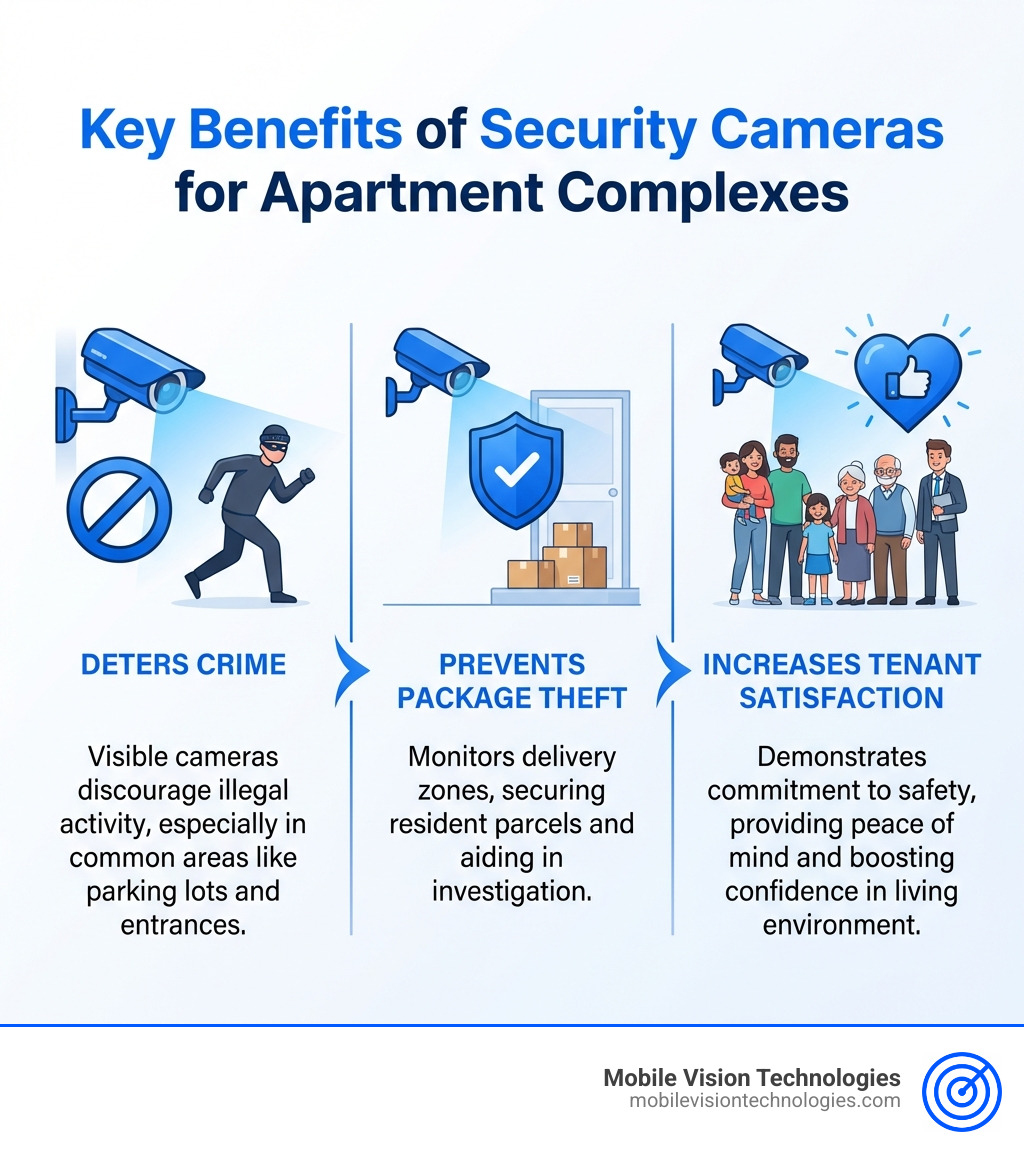
- Deters Crime: Visible cameras discourage criminals, especially in common areas like parking lots and entrances.
- Prevents Package Theft: Cameras monitor delivery zones, helping stop and investigate stolen packages.
- Boosts Tenant Confidence: 66% of renters prefer apartments with security cameras, showing a commitment to safety.
- Monitors Parking: Cameras can identify unauthorized vehicles or those parked too long.
- Provides Evidence: Footage helps law enforcement solve incidents and resolve disputes.
Property managers and owners face many challenges. Keeping residents safe and happy is a top priority. Crime rates, package theft, and unauthorized parking can reduce property value and lead to tenant dissatisfaction. Modern security camera systems offer powerful solutions to these issues.
These systems do more than just record events. They create a safer community and offer peace of mind. This guide will cover everything you need to know, from camera types to legal considerations and smart technologies.
I’m Chris Edens. I’ve dedicated my career to protecting people, first in the army and now by leveraging advanced technology like mobile surveillance. My expertise in security cameras for apartment complexes helps ensure safety without constant physical presence.
Why Security Cameras are a Smart Investment for Your Property
For property managers and owners in Memphis, TN, Bartlett, TN, Southaven, MS, Jackson, TN, Germantown, TN, Lakeland, TN, and Olive Branch, MS, investing in robust security cameras for apartment complexes isn’t just about reacting to problems; it’s a proactive strategy that offers numerous benefits. It improves the overall appeal and value of your property, securing your investment for the long term.
One of the most compelling reasons is crime deterrence. The visible presence of security cameras acts as a powerful deterrent, especially in common areas like parking lots and entrances. This can significantly reduce the likelihood of incidents occurring on your property. According to the FBI, residential properties are frequent targets for crime, with over 1.1 million burglaries reported in the U.S. in 2019, and 62.8% of these occurring in residential settings. These crimes resulted in nearly $3 billion in property losses, averaging $2,661 per incident. Having cameras in place can help avoid becoming another statistic.
Beyond deterrence, cameras provide invaluable visual evidence. If an incident does occur, clear footage can aid law enforcement in investigations, helping to identify suspects and lead to arrests. This evidence also reduces liability for property managers, protecting us from potential lawsuits by demonstrating that we’ve taken reasonable and effective steps to ensure safety.
Installing a comprehensive security system contributes to increased property value and can even lead to higher rental income. A reputation for high crime rates is a red flag for potential residents, making it harder to fill units and increasing tenant turnover, which can cost as much as $1,000 to $5,000 per unit. A secure environment is a major selling point, making your property more attractive to prospective tenants and fostering a loyal, satisfied resident base.
Enhancing Tenant Safety and Satisfaction
Our residents’ peace of mind is paramount. When we install security cameras for apartment complexes, we’re not just adding equipment; we’re building a stronger sense of community and security. A significant 66% of renters have indicated they would choose an apartment with security cameras over one without. This statistic clearly illustrates that safety features are a key differentiator in today’s competitive rental market.
Knowing that common areas, entrances, and parking lots are monitored can make a substantial difference in how safe residents feel. This feeling of security fosters a more positive living environment and contributes directly to tenant satisfaction and retention. When residents feel cared for and protected, they are more likely to renew their leases, reducing costly turnover for us. It sends a clear message that we are committed to their well-being and are actively investing in creating a secure sanctuary for them to call home.
Mitigating Common Apartment Complex Issues
Security cameras for apartment complexes are incredibly effective tools for tackling everyday nuisances that can quickly escalate into larger problems. Two of the most prevalent issues we face are package theft and unauthorized parking.
Package theft has become an unfortunate reality in high-density living environments. Strategically placed cameras in mailrooms, near main entrances, and at package delivery points can significantly deter these opportunistic criminals. If a package does go missing, the recorded footage provides crucial evidence to identify the thief, assist law enforcement, and resolve disputes. This proactive approach helps us protect residents’ belongings and their trust.
Unauthorized parking is another headache for property managers. Whether it’s vehicles parked in fire lanes, reserved spaces, or overstaying their welcome in visitor spots, it causes frustration for paying residents and can create safety hazards. Our advanced camera systems, especially those with License Plate Recognition (LPR) capabilities, can track vehicles entering and exiting the property. This allows us to identify vehicles that have been parked for longer than the allocated time or those occupying unauthorized spaces. For detailed solutions, explore our expertise in Parking Lot Security Cameras.
Beyond these, cameras are invaluable for deterring vandalism in common areas, monitoring after-hours activity in amenity spaces like pools or gyms, and even identifying individuals responsible for waste disposal violations. By providing clear visual records, we can address these issues quickly and effectively, maintaining a clean, safe, and respectful environment for everyone.
Types of Security Cameras and Their Ideal Placement
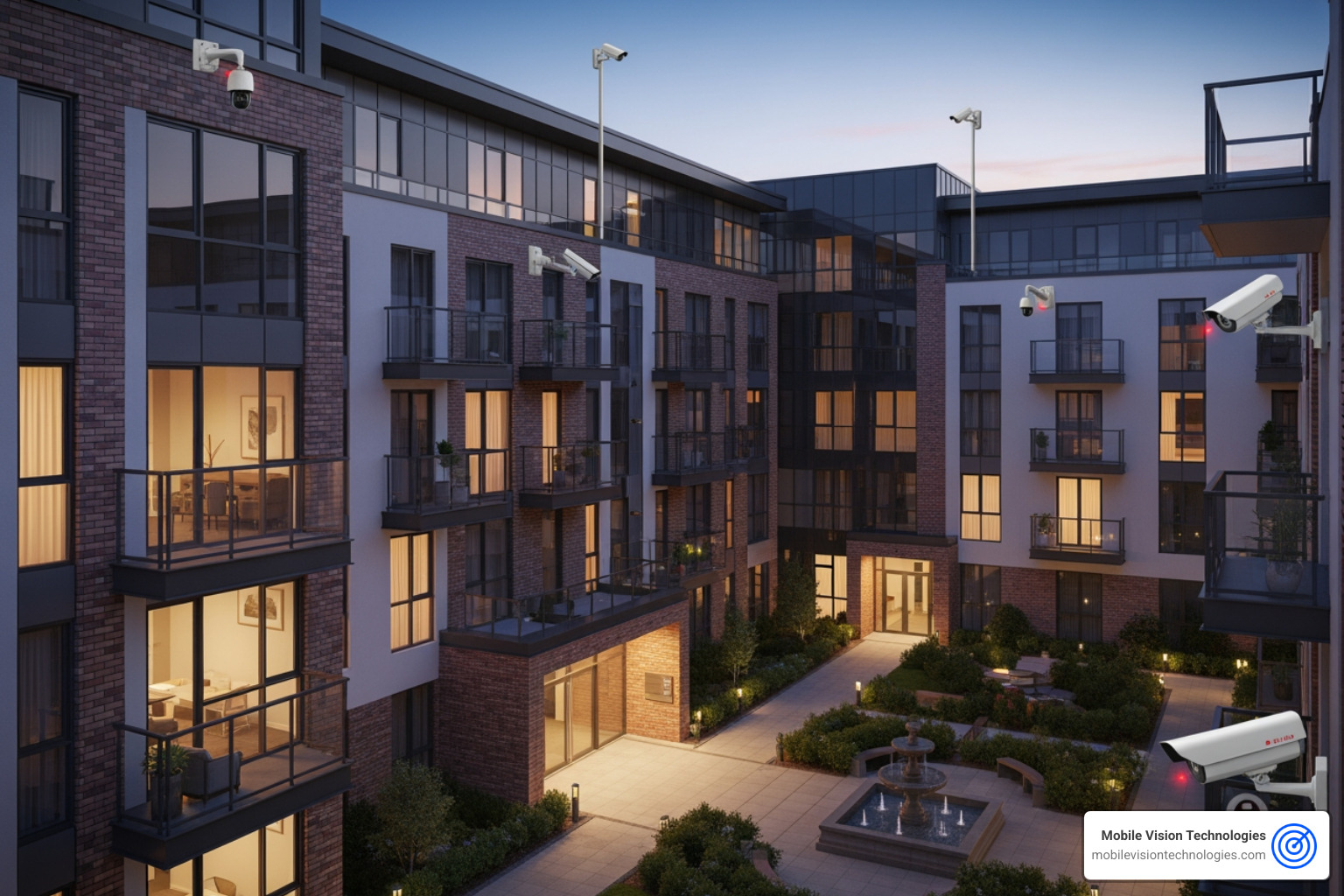
Choosing the right camera for the right location is key to building an effective surveillance system for apartment complexes. Different camera types excel in different scenarios, offering unique advantages in terms of coverage, visibility, and durability. Strategic placement ensures maximum coverage while minimizing blind spots, giving us comprehensive oversight of our property.
Choosing the Right Camera for the Job
When planning our security strategy, we consider a range of camera types, each designed for specific surveillance needs:
- Bullet Cameras: These are highly visible, cylindrical cameras ideal for long-distance surveillance. We often use them in parking lots, open courtyards, and along property perimeters. Their prominent design acts as a strong deterrent, and they can record clear video from ranges of 50-150 feet, with some specialized models reaching up to 300 feet.
- Dome Cameras: Known for their discreet and tamper-resistant design, dome cameras are excellent for indoor common areas like lobbies, hallways, and amenity spaces. Encased in a dome, their direction is less obvious, and they offer wide-angle or 360-degree coverage, making them less obtrusive while still providing comprehensive surveillance.
- PTZ (Pan-Tilt-Zoom) Cameras: These versatile cameras allow us to remotely control their horizontal (pan), vertical (tilt), and zoom functions. They are perfect for monitoring large, active areas that require constant oversight, such as large parking garages or expansive common grounds. Their ability to zoom in on details, like license plates, makes them invaluable for investigations.
- Turret Cameras: Often called “eyeball” cameras, turret cameras are similar to dome cameras but without the protective dome cover. They offer flexibility in positioning the lens and are robust for outdoor use, providing clear nighttime monitoring with reduced glare due to their flat lens. We find them effective in outdoor common areas where a less conspicuous but durable camera is needed.
- License Plate Recognition (LPR) Cameras: These specialized cameras are designed to capture vehicle license plates, make, model, and even color, often referred to as a “vehicle fingerprint.” They are crucial for managing vehicle access, identifying unauthorized vehicles, and providing critical evidence for law enforcement in cases involving cars. LPR cameras can effectively track vehicles and flag them if they are stolen or associated with a crime, greatly enhancing our parking lot security.
Strategic Placement for Maximum Coverage
Effective camera placement is about more than just pointing and shooting; it’s about intelligent design to eliminate vulnerabilities. We focus on key areas to ensure comprehensive coverage:
- Entrances and Exits: This includes pedestrian and vehicle entry points. Cameras here capture everyone and everything entering or leaving the property, acting as a first line of defense.
- Lobbies and Mailrooms: These high-traffic areas are prone to package theft and unauthorized access. Dome cameras work well here for their wide coverage and discreet nature.
- Parking Lots and Garages: Bullet cameras and LPR cameras are essential here to monitor vehicles, deter theft and vandalism, and manage parking enforcement. Our team can help you integrate these with your existing Access Control Systems for a seamless solution.
- Hallways and Stairwells: These are often less visible areas where incidents can occur. Dome cameras provide broad coverage and can capture activity in these transitional spaces.
- Amenity Areas (Pools, Gyms, Clubhouses): Cameras here help ensure residents are using facilities appropriately, deter vandalism, and provide evidence in case of accidents or unauthorized use.
- Perimeters and Fences: Bullet or turret cameras strategically placed along the property line can detect and deter potential intruders before they gain access to the complex.
By carefully selecting and positioning these different types of security cameras for apartment complexes, we can create a layered security system that protects our property and residents comprehensively.
Key Features to Look for in Security Cameras for Apartment Complexes
When selecting security cameras for apartment complexes, the hardware’s capabilities are just as important as its placement. Modern cameras come packed with features designed to improve surveillance, improve incident response, and simplify management. Here are the key features we prioritize:
- High Resolution (HD, 4K): Clarity is king when it comes to security footage. High-definition (HD) cameras, particularly those offering 2K or 4K resolution, provide sharp, detailed images that are crucial for identifying faces, license plates, and other critical information. This level of detail ensures that any evidence captured is truly actionable for law enforcement.
- Night Vision (Infrared, Color): Crime doesn’t sleep, and neither should our cameras. Most security cameras use infrared (IR) night vision for black-and-white images in low light or complete darkness. However, advanced systems also offer color night vision, which can provide more detailed and useful footage by capturing ambient light more effectively.
- Wide Field of View: The broader the camera’s field of view, the more area it can cover, potentially reducing the number of cameras needed. Wide-angle lenses are particularly useful in large common areas, lobbies, and parking lots. Some cameras, like fisheye or dual-head models, can provide exceptionally wide coverage.
- Motion Detection: This essential feature triggers recording only when movement is detected, saving storage space and making it easier to review relevant footage. Advanced motion detection can differentiate between people, vehicles, and animals, reducing false alarms.
- Durability (Weatherproofing, Vandal-proofing): For outdoor installations, cameras must withstand the elements. Look for weatherproofing ratings like NEMA 4x or IP65/IP66, which indicate protection against dust, rain, and extreme temperatures. Vandal-proof casings are also vital for cameras in publicly accessible areas to prevent tampering or damage.
- Video Storage (Cloud vs. Local NVR): How footage is stored impacts accessibility and security.
- Cloud Storage offers remote access, off-site backup, and often integrates with smart analytics, but typically involves ongoing subscription fees.
- Local NVR (Network Video Recorder) storage provides greater control over data, no recurring fees, and is often preferred for large-scale deployments where extensive footage needs to be retained. Many systems offer a hybrid approach, combining the best of both.
By carefully considering these features, we can select security cameras for apartment complexes that deliver superior performance, reliability, and value, ensuring our property remains safe and secure around the clock.
The Role of AI and Smart Analytics in Modern Surveillance
The evolution of security cameras for apartment complexes has moved far beyond simple recording. Today, Artificial Intelligence (AI) and smart analytics are changing surveillance systems into proactive security powerhouses. These advanced capabilities allow our systems to not just observe, but to analyze, alert, and even deter, significantly enhancing safety and operational efficiency.
AI-powered surveillance shifts our security strategy from reactive to proactive. Instead of merely reviewing footage after an incident, our systems can detect anomalies in real-time and issue immediate alerts. This dramatically reduces false alarms by intelligently distinguishing between genuine threats and everyday occurrences, saving valuable time and resources. For a deeper dive into these capabilities, explore our AI-Powered Video Surveillance solutions.
How AI improves security for apartment complexes
AI brings a new level of intelligence to our security operations:
- Person and Vehicle Detection: Our cameras can accurately identify and track people and vehicles, ignoring irrelevant movements like swaying trees or small animals. This ensures that alerts are highly relevant, allowing security personnel to focus on actual threats.
- Loitering Detection: AI can identify individuals or vehicles that remain in a specific area for an unusual amount of time, flagging potential suspicious activity or unauthorized presence in common areas or parking lots.
- License Plate Recognition (LPR): As mentioned earlier, LPR cameras use AI to read and record license plates. This is invaluable for vehicle access control, tracking unauthorized vehicles, and providing critical evidence for law enforcement. Some systems can even alert us if a vehicle on a “hot list” (e.g., stolen, associated with a crime) enters the property.
- Automated Deterrence (Lights, Audio): Some AI-powered cameras can be programmed to trigger automated responses to detected threats. This might include flashing lights or playing pre-recorded audio warnings to deter trespassers or vandals, often before an incident escalates.
- Forensic Search: When an incident occurs, AI capabilities allow for rapid and intelligent searching through vast amounts of footage. We can quickly filter by person, vehicle, color, direction of travel, or time, significantly speeding up investigations and evidence retrieval.
Integrating Systems for Centralized Management
For apartment complexes, especially those with multiple buildings or locations, a unified security platform is essential for efficient management. AI-powered systems facilitate this by offering:
- Unified Security Platform: This brings all security devices – cameras, access control, alarms – under a single, intuitive interface. Our property managers can monitor their entire portfolio from one dashboard, whether they’re on-site or off.
- Integration with Access Control: Seamlessly combining video surveillance with access control systems allows for visual verification of individuals entering restricted areas. If an access card is used, the system can pull up the corresponding video, enhancing security and accountability.
- Remote Monitoring: Managers can access live feeds and recorded footage from anywhere via secure internet connections. This is particularly beneficial for properties in Memphis, TN, Bartlett, TN, Southaven, MS, Jackson, TN, Germantown, TN, Lakeland, TN, and Olive Branch, MS, allowing for flexible oversight and quick response times.
- Streamlined Workflows: AI and integration reduce the manual effort required for surveillance. Incidents are flagged automatically, evidence is easier to retrieve, and communication between security personnel and management is more efficient. We specialize in providing Multi-Location Security Solutions & Mobile Surveillance Systems that centralize these operations for maximum effectiveness.
By leveraging AI and smart analytics, our security cameras for apartment complexes become intelligent guardians, offering unparalleled protection and efficiency for our properties and residents.
Navigating Legal, Installation, and Budgetary Considerations
Implementing security cameras for apartment complexes involves more than just picking out the right equipment. We must carefully consider legal implications, practical installation challenges, and long-term budgetary commitments. A well-thought-out plan in these areas ensures compliance, effectiveness, and a sustainable security solution.
| Feature | Wired Systems (e.g., PoE) | Wireless Systems (e.g., Wi-Fi, Battery) |
|---|---|---|
| Pros | – More reliable connection (less interference) | – Easier installation (no extensive wiring) |
| – Consistent power supply | – Flexible placement (battery/solar options) | |
| – Higher bandwidth, better for high-res video | – Often more affordable upfront | |
| – Improved security (less susceptible to hacking) | ||
| Cons | – More complex installation (running cables) | – Can be prone to signal interference |
| – Higher installation costs | – Battery life management (recharging/replacing) | |
| – Less flexible placement once installed | – Limited bandwidth for high-res, continuous recording | |
| – Potential for hacking if not properly secured | ||
| Best Use Cases | – Permanent installations | – Temporary monitoring |
| – Areas needing 24/7, high-quality recording | – Areas difficult to wire | |
| – Critical infrastructure areas | – Individual unit security (with landlord approval) |
Understanding the total cost of ownership, scalability for future needs, and whether professional installation is required are all crucial aspects we consider.
Understanding Privacy Laws and Tenant Rights
Navigating privacy laws is paramount when installing security cameras for apartment complexes. While enhancing security, we must always respect our residents’ reasonable expectation of privacy.
Generally, cameras are permissible in common areas where there is no reasonable expectation of privacy, such as lobbies, hallways, amenity spaces, parking lots, and building entrances/exits. However, we must never place cameras in areas considered private, such as inside apartments, bathrooms, or pointed directly into apartment windows. Doing so could lead to legal issues and erode tenant trust.
The Bureau of Justice Statistics highlights that apartment renters, especially those in smaller complexes, are more prone to experiencing crime. This underscores the need for effective security, but it doesn’t override privacy rights. We ensure clear signage is posted informing residents and visitors that surveillance is in operation. Consulting legal counsel to understand local and state regulations in Memphis, TN, and surrounding areas is a critical step to ensure full compliance and avoid unintended privacy violations.
Installation, Power, and Connectivity for security cameras for apartment complexes
The practicalities of installation, power, and connectivity dictate the type of system we can implement.
- Wired (PoE) Systems: Power over Ethernet (PoE) cameras receive both power and data through a single Ethernet cable. These systems offer highly reliable connections, consistent power, and robust security. They are ideal for permanent installations requiring 24/7, high-quality recording, though they involve more complex and costly installation due to cable routing.
- Wireless (Wi-Fi) Systems: These cameras connect to the internet via Wi-Fi and often run on batteries or solar power, making them easier to install in areas difficult to wire. While convenient and often more affordable upfront, we must consider battery life management, potential signal interference, and bandwidth limitations, especially for continuous high-resolution recording. Solar-powered options are excellent for outdoor areas without easy access to power.
- Power Sources: For wired systems, a stable power supply is critical. For wireless, battery life and charging solutions (including solar panels) need careful consideration to ensure continuous operation.
- Internet Bandwidth Requirements: High-resolution cameras, especially those with continuous recording or advanced AI analytics, demand significant internet bandwidth. We assess our property’s network infrastructure to ensure it can support the chosen camera system without performance issues.
For renters looking to install cameras inside their individual units, landlord approval is often required, particularly if any permanent fixtures or wiring modifications are involved. Even for battery-operated cameras, it’s always best to check with property management. For comprehensive solutions including professional assessment, installation, maintenance, and monitoring, we offer expert services in Installation, Maintenance & Monitoring.
Budgeting for Your Security System
Budgeting for security cameras for apartment complexes involves more than just the initial purchase price. We consider a holistic view of costs to ensure a sustainable and effective security investment:
- Upfront Hardware Costs: This includes the cameras themselves, recording devices (NVRs), and any necessary networking equipment. These costs vary widely based on resolution, features, and durability.
- Installation Fees: Professional installation ensures optimal placement, proper wiring, and system configuration. While an upfront cost, it prevents costly mistakes and ensures system reliability.
- Subscription and Storage Fees: Cloud storage, advanced AI analytics, and remote monitoring services often come with recurring monthly or annual subscription fees. We factor these into the long-term budget.
- Long-Term Maintenance: Cameras and systems require periodic maintenance, including cleaning, software updates, and occasional repairs. Allocating funds for this ensures the system remains operational and effective.
- Return on Investment (ROI): While there are direct costs, the ROI of a robust security system is significant. It can reduce tenant turnover (saving $1,000 to $5,000 per unit), deter crime (saving thousands in property losses), lower insurance premiums, and increase property value and tenant satisfaction, ultimately benefiting our bottom line. Starting small and scaling up can also help manage initial financial outlays.
By carefully planning these aspects, we can implement an effective and budget-conscious security solution for our apartment complexes.
Frequently Asked Questions about Apartment Complex Cameras
How do security cameras help with package theft?
Cameras are incredibly effective against package theft by creating a comprehensive visual record. Placed strategically in mailrooms, near main entrances, and at package drop-off points, they deter potential thieves. If a package does go missing, the footage provides crucial evidence of who delivered it, when, and who may have taken it. This evidence is invaluable for investigations and for resolving disputes with residents and delivery services.
Do security cameras actually deter crime in apartment complexes?
Yes, absolutely. The visible presence of security cameras for apartment complexes acts as a significant deterrent. Criminals are less likely to target properties where they know their actions will be recorded. Cameras signal that the property is monitored and that there’s a higher chance of being identified and caught, making it a less attractive target compared to properties without surveillance. This deterrent effect is especially strong in common areas like parking lots, lobbies, and entrances.
What are the rules for placing cameras in common areas?
When placing cameras in common areas, we operate under the principle of respecting the reasonable expectation of privacy. Cameras are generally permitted in public or common areas such as lobbies, parking lots, hallways, laundry rooms, and amenity spaces. In these areas, individuals typically do not have an expectation of privacy.
However, cameras should never be positioned to view the inside of tenants’ apartments, bathrooms, locker rooms, or other areas where privacy is reasonably expected. It’s crucial to comply with all local and state laws in areas like Memphis, TN, and to clearly inform residents about the presence of surveillance through visible signage. Our aim is always to improve security without infringing on residents’ rights.
Secure Your Community with a Professional Solution
Choosing the right security system is a critical decision that impacts tenant safety, property value, and operational efficiency. By understanding the different camera types, essential features, and the power of AI analytics, you can build a robust surveillance strategy. For a comprehensive and flexible approach that combines advanced technology with expert service, consider a professional provider like Mobile Vision Technologies. A custom mobile video surveillance solution can provide the peace of mind you and your residents deserve.