
AI object recognition: Magic of 2026 Vision
Why AI Object Recognition Matters for Modern Security
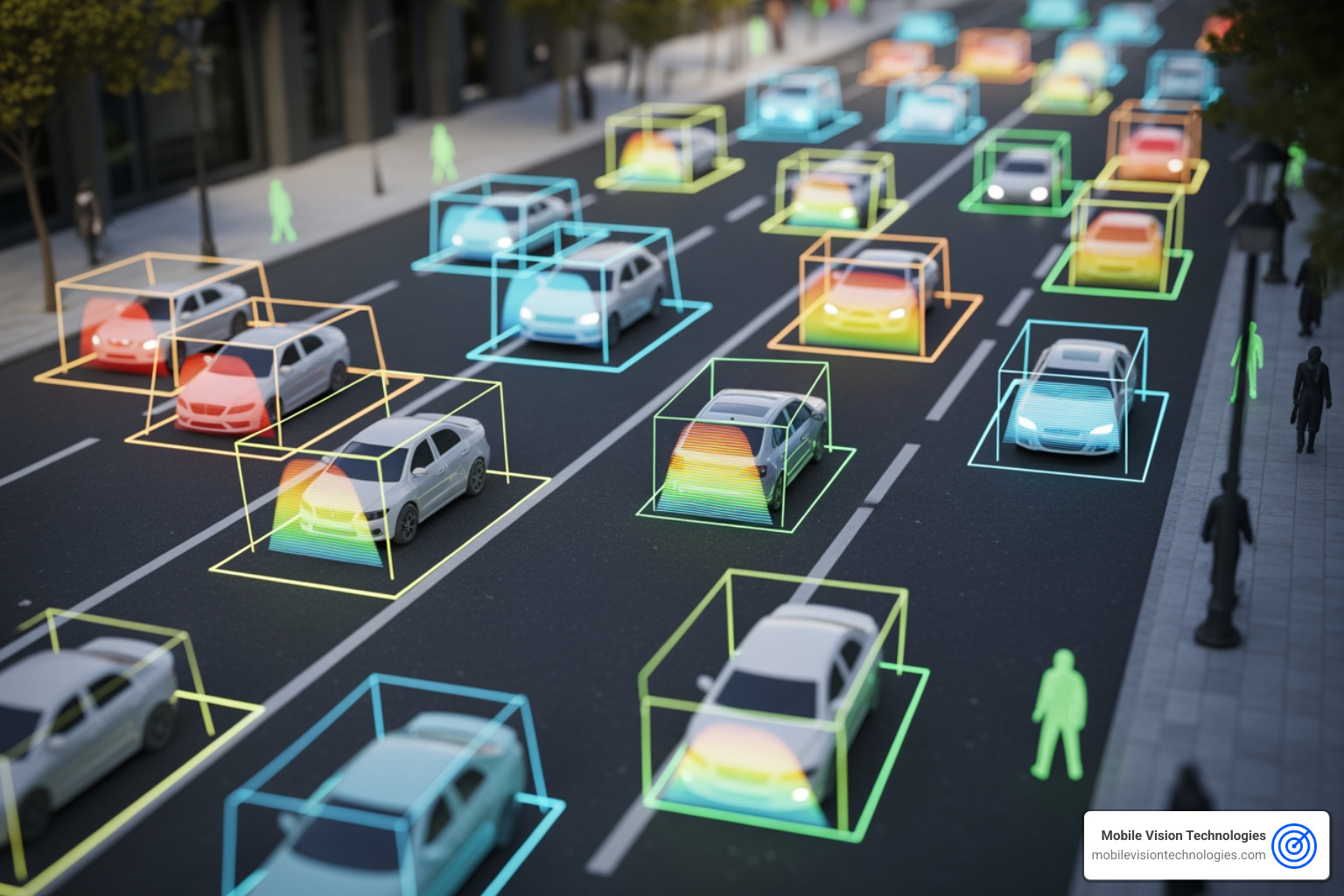
AI object recognition is a computer vision technology that enables machines to identify and locate specific objects within images or video streams. Unlike simple motion detection or image tagging, it provides precise information about what objects are present and where they are located, typically by drawing bounding boxes around detected items and assigning confidence scores.
Key Capabilities of AI Object Recognition:
- Object Classification – Identifies what an object is (person, vehicle, animal, etc.)
- Object Localization – Provides exact pixel coordinates showing where objects appear
- Instance Counting – Tracks how many objects of each type are present
- Real-Time Analysis – Processes video streams continuously, typically at 30+ frames per second
- Contextual Understanding – Distinguishes between normal activity and potential threats
Picture this: You receive a notification from your security camera that motion has been detected. But instead of just seeing pixels change on screen, the system tells you exactly what triggered the alert—a person in a red hoodie near your perimeter fence at 2 AM, not just a stray dog or swaying tree branch. That’s the power of AI object recognition, and it’s changing how businesses protect their assets.
For property managers and business owners securing large, remote, or temporary sites, this technology represents a fundamental shift from reactive surveillance to proactive protection. Traditional security cameras simply record footage for later review. AI object recognition turns every camera into an intelligent guardian that understands what it’s seeing, filters out false alarms, and alerts you only when it matters.
The stakes are high. According to U.S. Department of Justice statistics, parking lots alone see about 1,400 security incidents daily, making them the third most crime-prone areas in the country. Meanwhile, security guard attention spans drop after just 20 minutes of monitoring multiple video feeds. AI doesn’t get tired, doesn’t miss details, and can watch dozens of camera angles simultaneously while distinguishing a delivery driver from a potential intruder.
I’m Chris Edens, and I’ve spent my career protecting people and property—first in the Army, now through advanced technology that doesn’t require boots on the ground. AI object recognition has become the cornerstone of how we deploy intelligent mobile surveillance that works 24/7 in any environment, from construction sites to retail parking lots.
What is AI Object Recognition and How Does It Differ?
At its heart, AI object recognition is about giving machines the ability to “see” and “understand” the world in a way that’s useful for specific tasks. It’s a key branch of computer vision that goes beyond simply acknowledging the presence of an object; it pinpoints its exact location.
The Core Task: More Than Just Seeing
When we talk about AI object recognition, we’re typically referring to a process that involves both identifying what an object is and where it is in an image or video. This is often called object detection. To clarify, let’s look at how it differs from other related computer vision tasks:
- Object Detection vs. Image Classification: Image classification is like looking at a picture and saying, “This is a picture of a cat.” It tells you the primary subject or category of the entire image. Object detection, on the other hand, is like saying, “There’s a cat here, and it’s right there (drawing a box around it), and also a dog here (drawing another box).” It identifies multiple objects and their precise locations within an image.
- Object Detection vs. Image Tagging: Image tagging provides general labels for an image, which can include contextual terms that cannot be localized with bounding boxes. For example, a tag might be “outdoor scene,” “sunny day,” or “group of people.” Object detection is more granular, returning bounding box coordinates for specific, locatable objects like “person,” “car,” or “tree.” While tagging gives you broad context, object detection gives you specific instances and their positions. As IBM explains, object detection identifies objects in an image and returns their bounding box coordinates. You can learn more about this distinction on their page: What is object detection?
AI object recognition focuses on localizing objects and living things. It doesn’t just recognize a category; it finds every instance of that category in the frame.
The Output: What the AI Tells Us
The magic of AI object recognition isn’t just in finding objects, but in how it communicates that information. When an AI model processes an image or video frame, its output for each detected object typically includes:
- Object Labels: A classification of what the object is (e.g., “person,” “vehicle,” “forklift,” “intruder”).
- Confidence Scores: A percentage or probability indicating how confident the AI is in its classification. A score of 95% means the AI is very sure it’s identified correctly, while a lower score might prompt further review.
- Pixel Coordinates: The precise location of the object within the image, usually represented as a bounding box (x, y, width, height) that perfectly encloses the object.
- Instance Counting: By drawing unique bounding boxes around each instance, the system can easily count how many of a particular object type are present in the scene. This is invaluable for applications like people counting in retail or tracking inventory in a warehouse.
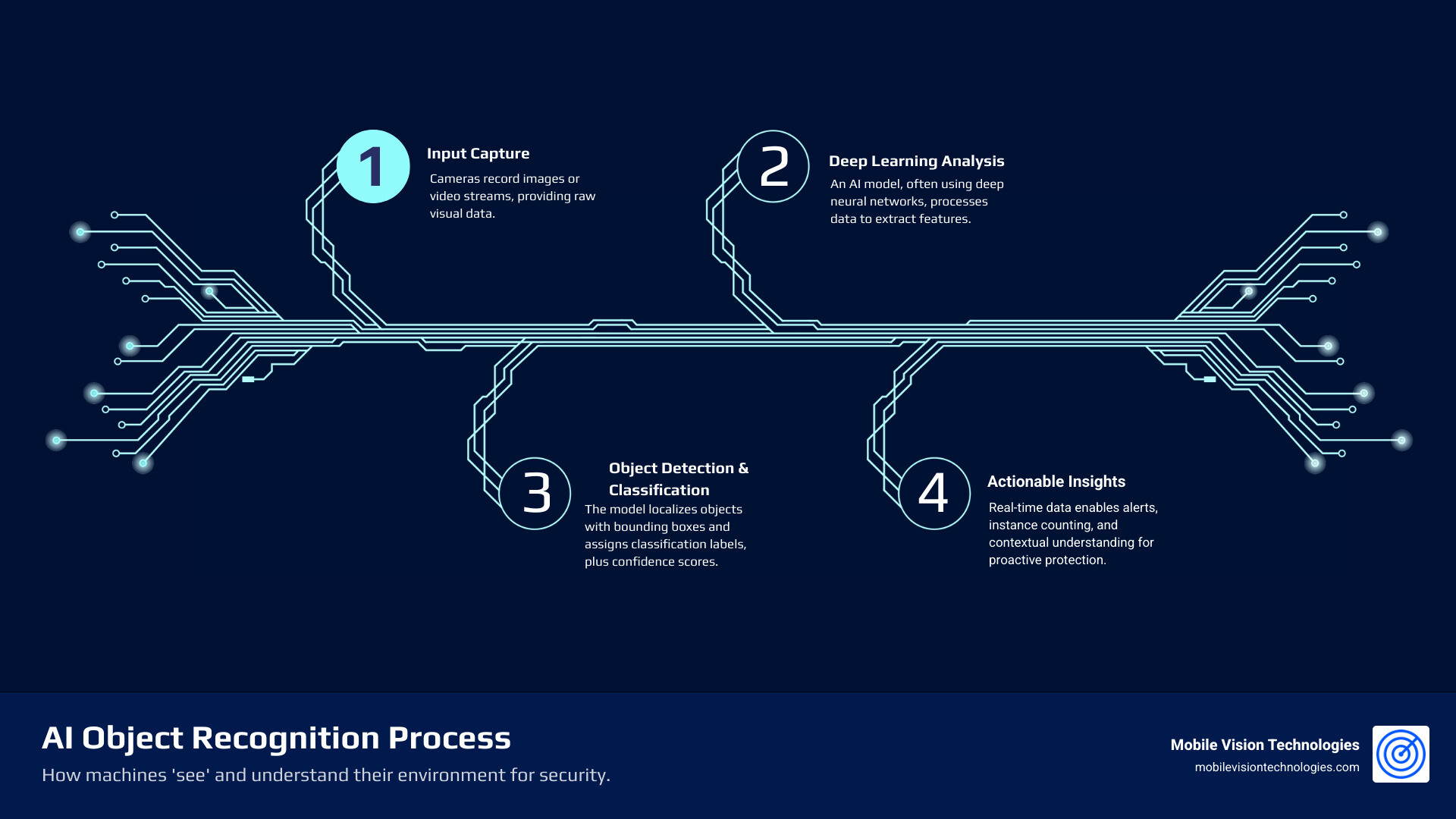
This structured output allows subsequent systems to take automated actions, whether it’s alerting security personnel, triggering a deterrent, or updating inventory records.
How Modern AI Object Recognition Works
The ability of computers to “see” objects has been revolutionized by deep learning, a powerful subset of artificial intelligence.
The Engine: Core Components and Methodologies
Modern AI object recognition relies on Convolutional Neural Networks (CNNs), which are complex digital brains trained to spot patterns in visual data. They process images using several key components:
- Backbone Architecture: Extracts basic features from an image, like edges, textures, and shapes.
- Feature Pyramids: Help the model detect objects at various sizes and distances by processing the image at multiple resolutions.
- Prediction Head: Makes the final predictions, generating the bounding box coordinates, class label, and confidence score for each object.
These deep learning models automatically learn from raw pixels, significantly outperforming older image processing techniques. For a deeper dive, you can explore comprehensive surveys on the topic: A survey of deep learning-based object detection.
Training and Evaluating Models
Building a powerful model requires massive amounts of data and rigorous evaluation.
- Supervised Learning: Most models are trained using supervised learning. Humans first “label” millions of images by drawing bounding boxes around objects and assigning class labels (e.g., “car,” “person”). The AI then learns to associate visual patterns with these labels.
- Labeled Datasets: The quality of labeled data is paramount. Datasets like COCO (Common Objects in Context) and Open Images V4 are industry standards. The Open Images V4 dataset, for example, contains over 15 million bounding boxes across 600 object classes, helping train robust and accurate models. You can read more about this dataset here: The Open Images Dataset V4.
- Metrics: We evaluate model performance using specific metrics:
- Mean Average Precision (mAP): The gold standard for accuracy, measuring the precision of bounding boxes and classifications.
- Frames Per Second (FPS): Measures processing speed, which is crucial for real-time applications like security surveillance.
The Power Behind the Scenes: Hardware and Software
Advancements in AI object recognition are powered by strides in hardware and software.
- Graphics Processing Units (GPUs) and AI Accelerators: GPUs and specialized AI accelerators are essential for performing the billions of calculations required by deep learning models, enabling faster training and real-time performance.
- Edge AI: For our mobile surveillance systems, Edge AI is a game-changer. Instead of sending video to a distant cloud server, Edge AI runs models directly on devices—like our mobile surveillance units in Memphis, Bartlett, and Southaven. This reduces latency, lowers bandwidth costs, and enables real-time decisions, even with limited connectivity.
- Computer Vision Libraries: Developers use powerful software frameworks (like TensorFlow, PyTorch, and OpenCV) to efficiently build, train, and deploy these complex models.
Ensuring data security, whether on the edge or in the cloud, is a top priority. You can find more information about our data security practices here: More info about our secure data services.
The Evolution of Object Detection Algorithms
The journey of AI object recognition is one of continuous innovation in pursuit of speed and accuracy.
From Hand-Crafted Features to Deep Learning
Before deep learning, researchers designed algorithms to identify specific image features.
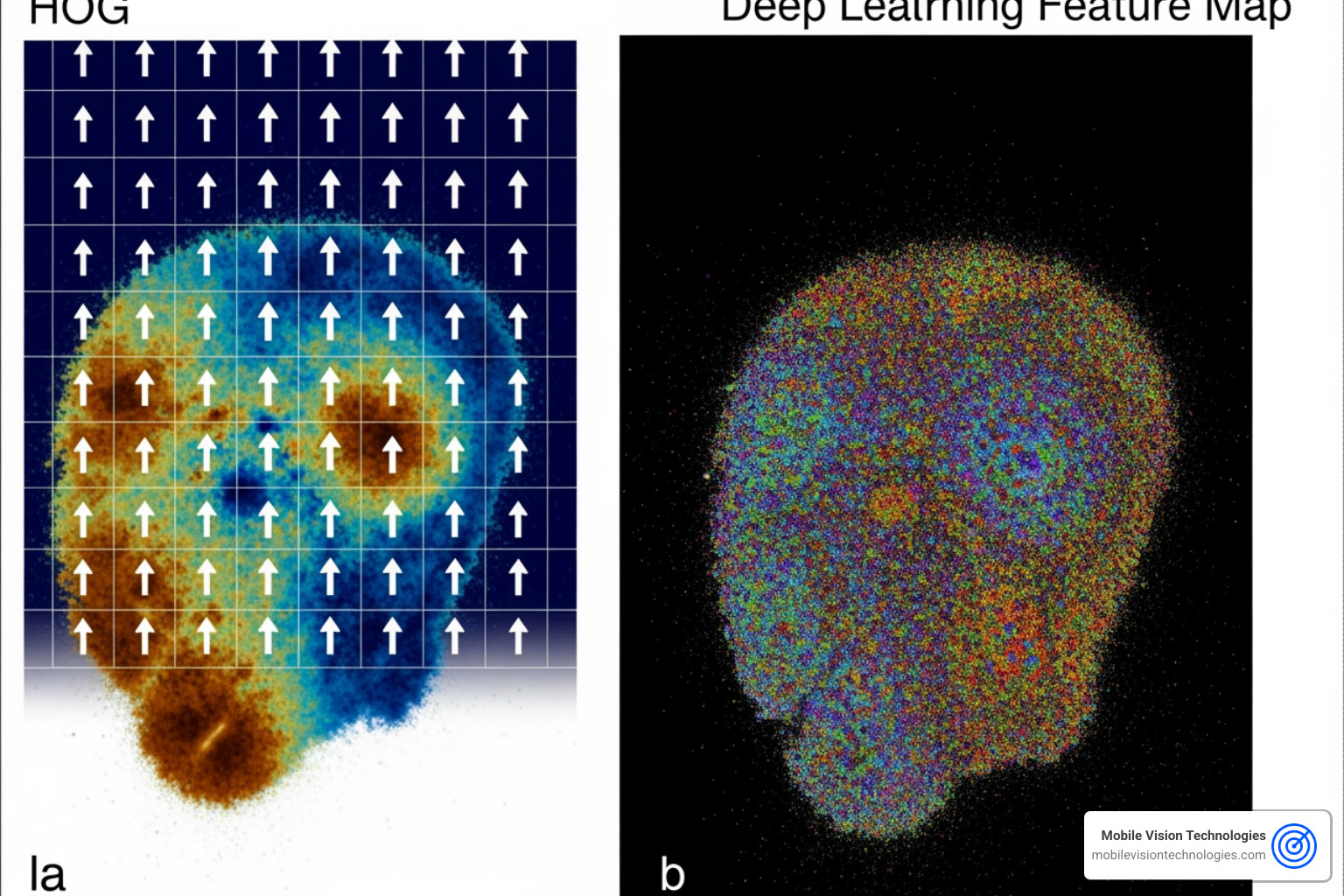
- Early Approaches (Pre-2012): Methods like the Viola-Jones Framework (2001) for face detection and Histograms of Oriented Gradients (HOG) (2005) for human detection were groundbreaking. However, these traditional methods relied on “hand-crafted” features and struggled with variations in lighting or object pose. You can read about this pioneering research on HOG for human detection.
- The Deep Learning Revolution (Post-2012): The R-CNN Family
The breakthrough came with Convolutional Neural Networks (CNNs), which learn features automatically from data. The R-CNN (Region-based CNN) family marked a turning point by applying CNNs to object detection. Subsequent versions like Fast R-CNN and Faster R-CNN dramatically increased speed, while Mask R-CNN added the ability to outline each object at a pixel level. These models are far more robust in complex scenes than their predecessors.
One-Stage vs. Two-Stage Detectors
Deep learning detectors fall into two main categories:
| Feature | Two-Stage Detectors (e.g., R-CNN Family) | One-Stage Detectors (e.g., YOLO Family, SSD) |
|---|---|---|
| Process | 1. Propose regions of interest. 2. Classify and refine bounding boxes. | Directly predict bounding boxes and class probabilities in a single pass. |
| Accuracy | Generally higher, especially for small or complex objects. | Good, but sometimes slightly lower than two-stage for very challenging cases. |
| Speed | Slower (more computations due to two steps). | Faster, designed for real-time applications. |
| Complexity | More complex pipeline. | Simpler, more unified architecture. |
| Best Use Case | Applications requiring highest possible accuracy, less real-time demand. | Real-time surveillance, autonomous driving, video analytics. |
A Look at Leading Algorithm Families
Today, several algorithm families dominate AI object recognition:
- R-CNN Family (Fast, Faster, Mask R-CNN): These two-stage detectors are pioneers known for their high accuracy, making them ideal when precision is the top priority.
- YOLO Family (You Only Look Once): YOLO revolutionized real-time detection by processing the entire image in a single pass. This one-stage approach makes it incredibly fast. The original YOLO paper laid the foundation for this method. Modern versions like YOLOv7 offer a state-of-the-art balance of speed and accuracy, making them ideal for real-time mobile surveillance.
- SSD (Single Shot MultiBox Detector): Like YOLO, SSD is a fast one-stage detector that identifies objects of various sizes in a single pass.
The choice of algorithm depends on the application’s need for speed versus accuracy. For mobile surveillance, real-time performance is critical, making one-stage detectors like YOLO especially valuable.
Real-World Applications: How AI Object Recognition is Changing Our World
The capabilities of AI object recognition are reshaping industries, enhancing safety, and driving automation across the United States, including our local communities in Memphis, Jackson, and Olive Branch.
Security and Surveillance
This is where AI object recognition truly shines. We leverage this technology extensively in our intelligent mobile surveillance systems to protect people and property.
- Threat Detection & Intrusion Alerts: Our systems distinguish between harmless animals and actual intruders, filtering out false alarms. If a person enters a restricted area on a construction site in Memphis after hours, our AI identifies them and triggers an immediate alert, enabling proactive deterrents that stop incidents before they escalate.
- Forensic Analysis: After an event, AI allows for rapid video review. Instead of sifting through hours of footage, we can search for specific objects (e.g., “blue truck,” “person with backpack”) to pinpoint when and where they appeared, dramatically speeding up investigations.
- People Counting: Our AI can accurately count individuals entering or exiting an area, providing valuable data for safety compliance and operational insights.
- Improved Parking Lot Security: Our mobile surveillance solutions use AI object recognition to monitor vast parking lots, detect suspicious activity, and identify vehicles, improving safety in these crime-prone areas. Explore our solutions: Parking Lot Security Cameras Memphis TN | Mobile Surveillance Solutions.
- Construction Site Monitoring: We protect vulnerable construction sites from theft and vandalism by detecting unauthorized entry and monitoring equipment. Learn more: Construction Site Surveillance Systems Memphis TN.
Our approach to AI-Powered Video Surveillance integrates these capabilities to provide unparalleled real-time safety.
Autonomous Driving and Transportation
AI object recognition is also indispensable for autonomous vehicles and smart transportation. It enables self-driving cars to detect pedestrians and other vehicles, read traffic signs, and identify road hazards. This technology is also used in smart cities to monitor traffic flow and manage congestion. The challenges and advancements in this field are continuously being researched: Status and Open Challenges in Autonomous Vehicles.
Retail and Healthcare
Beyond security, AI object recognition drives efficiency in other sectors.
- Retail: AI helps with inventory management by monitoring shelves, analyzing customer behavior (anonymously), and preventing loss. Our Warehouse Security Systems & Industrial Mobile Surveillance bring these capabilities to industrial settings.
- Healthcare: AI assists in medical image analysis (detecting tumors in X-rays), improves surgical precision, and monitors patients for events like falls.
These diverse applications demonstrate the transformative power of AI object recognition to automate tasks and improve safety.
Challenges and the Future of Object Detection
While AI object recognition has made incredible strides, it’s a rapidly evolving field with ongoing challenges and exciting future directions. We’re constantly working to push the boundaries of what’s possible.
Overcoming Current Limitations
Even the most advanced AI object recognition models aren’t perfect. We face several problems:
- Small Objects: Detecting very small objects in a large image remains a significant challenge. If an object is less than 5% of the image size, or too closely arranged with others (like a stack of plates), it’s often difficult for the AI to reliably detect and classify it.
- Occluded Objects: When objects are partially hidden or overlapping, the AI has less visual information to work with, making accurate detection harder. Imagine a person partially obscured by a parked car—the AI needs to infer their presence despite incomplete data.
- Class Imbalance: In real-world datasets, some objects appear far more frequently than others. This “class imbalance” can lead to models that are very good at detecting common objects but struggle with rare ones. Researchers are actively addressing these imbalance problems to improve robustness, as highlighted in academic reviews: A review on imbalance problems in object detection.
- Adverse Conditions: Poor lighting, heavy rain, fog, or extreme angles can significantly degrade the performance of AI object recognition systems. Our mobile surveillance units are designed to operate in various conditions, but these environmental factors remain a challenge for optimal AI performance.
Addressing these limitations requires continuous research into more robust algorithms, more diverse training data, and innovative techniques to handle visual ambiguities.
Emerging Trends and What’s Next
The future of AI object recognition is bright, with several exciting trends on the horizon:
- Vision Transformers (ViT): Traditionally, CNNs have dominated computer vision. However, models based on the Transformer architecture (originally used for natural language processing) are gaining traction. These “Vision Transformers” can process images more holistically and are showing promising results in end-to-end object detection: End-to-End Object Detection with Transformers.
- Agentic AI and Reasoning-Driven Detection: This is a cutting-edge development where AI models can identify objects based on text prompts and reasoning, rather than requiring extensive custom training and labeling. Imagine asking an AI, “Find the unripe strawberry” or “Locate the person without a hard hat.” This “reasoning-driven AI” uses intrinsic attributes, specific identities, contextual relationships, and dynamic states to achieve human-like precision. This approach significantly reduces the need for costly data labeling and custom model training, making AI object recognition more adaptable and accessible.
- Advanced Video Object Detection: Beyond simply detecting objects in single frames, the focus is shifting to understanding object interactions and movements over time. This includes:
- Object Tracking: Following a specific object (e.g., a person or vehicle) as it moves through a scene.
- Multiple Object Type Detection: Identifying and tracking various types of objects simultaneously within a video stream.
- Visual Relation Detection: Understanding the relationships between objects (e.g., “person riding bicycle,” “car parked next to building”).
- Continuous Improvement in Real-Time Performance: The demand for faster, more accurate real-time processing continues to drive innovation. We can expect even more efficient algorithms and hardware that enable instantaneous AI object recognition for critical applications like security.
These advancements promise to make AI object recognition even more powerful, adaptable, and integrated into our daily lives, further enhancing the capabilities of intelligent surveillance and automation.
Frequently Asked Questions about AI Object Recognition
We often get asked about the specifics of AI object recognition and what it truly entails. Here are answers to some common questions:
What is the difference between object detection and object recognition?
Object recognition is a broader term that can include classification (what is it?), while object detection is more specific, involving both classification and localization (what is it and where is it?). Most modern systems use “object detection” for the combined task. When we talk about AI object recognition in the context of security, we’re almost always referring to object detection—identifying and precisely locating items of interest.
How accurate is AI object recognition?
Accuracy varies based on the model, training data, and task complexity. State-of-the-art models like YOLOv7 can achieve over 56% mean Average Precision (mAP) on standard benchmarks, which is highly effective for many real-world applications. For example, YOLOv7 achieves 56.8% AP, outperforming many other detectors. While not 100% perfect (no AI is), the accuracy is sufficient to significantly improve human decision-making and automate critical tasks.
Can object detection work in real-time?
Yes, absolutely! Many algorithms, particularly one-stage detectors like the YOLO family, are optimized for speed and can process video streams in real-time (30 FPS or higher) on appropriate hardware. For example, YOLOv7 can operate in the range of 5 FPS to 160 FPS, making it suitable for live video surveillance. This real-time capability is essential for immediate alerts and responses in security applications. We ensure our platforms support real-time updates for maximum effectiveness: More info about real-time updates.
Conclusion
The journey through AI object recognition reveals a transformative technology that is continuously evolving, pushing the boundaries of what machines can “see” and “understand.” From its humble beginnings with hand-crafted features to today’s sophisticated deep learning models, AI has moved from merely classifying images to precisely locating and identifying multiple objects in real-time, even distinguishing between a delivery driver and a potential intruder in challenging conditions.
For businesses and communities in Memphis, Jackson, Lakeland, and beyond, this means a fundamental shift in how we approach security and operational intelligence. No longer are we limited to passive monitoring; instead, we can deploy intelligent guardians that proactively detect, analyze, and alert only when necessary, drastically reducing false alarms and empowering faster, more informed responses. This technology enables unprecedented levels of vigilance and efficiency, turning raw video footage into actionable insights that protect people, property, and assets.
At Mobile Vision Technologies, we combine advanced IoT expertise with traditional security experience to deliver flexible, full-service protection. By leveraging advanced AI object recognition, we equip our mobile surveillance systems with the intelligence needed to operate as a force multiplier, amplifying the efforts of human security teams. The future of security is intelligent, proactive, and deeply integrated with the power of AI.
To see how this technology can protect your assets, explore our AI-Powered Video Surveillance solutions.