
Smart intrusion prevention: Advanced Protection 2026
Why Smart Intrusion Prevention is the Future of Security
Smart intrusion prevention is an AI-powered security technology that analyzes surveillance footage in real-time to identify genuine threats—like people or vehicles—while filtering out false alarms caused by animals, weather, or environmental changes. Unlike traditional motion detection systems that trigger on any movement, smart intrusion prevention uses machine learning to differentiate between actual intruders and harmless activity, reducing false alarm rates to less than 3% and enabling security teams to respond faster to real threats.
Key advantages of smart intrusion prevention:
- Dramatically fewer false alarms – filters out non-threats like animals, weather, and lighting changes automatically
- Rapid event retrieval – search recorded footage by target type (person, vehicle) instead of manually reviewing hours of video
- Proactive threat detection – stops intruders before incidents escalate, not just after damage is done
- Works with existing cameras – NVR-side AI can upgrade regular surveillance systems without replacing hardware
- Proven results – documented 62% reduction in high-risk crimes and 70% decrease in overall incidents
Traditional security systems are failing businesses. PIR sensors trigger on passing animals. Electric fences provide no visual confirmation. Basic motion detection floods security teams with hundreds of false alerts per week—until they start ignoring them entirely. That’s when real threats slip through.
The problem isn’t just wasted time. It’s wasted opportunity. Security personnel spend hours reviewing irrelevant footage or responding to non-threats. By the time they locate a genuine incident in the recordings, valuable evidence has been buried under gigabytes of meaningless data.
Smart intrusion prevention flips this model. Instead of reacting to every movement, AI algorithms analyze behavior patterns and classify detected objects. A stray dog in the parking lot? Ignored. A person climbing a fence at 2 AM? Instant alert with video evidence. The system learns what normal activity looks like at your site and flags deviations that matter.
This shift from reactive to proactive security is changing how businesses protect remote properties, construction sites, warehouses, and parking facilities. The technology combines computer vision, deep learning, and cloud connectivity to deliver what traditional systems can’t: accurate threat identification without the noise.
I’m Chris Edens, and I’ve spent my career protecting people—first in the army, now through advanced surveillance technology that doesn’t require boots on the ground. Smart intrusion prevention represents the most significant leap forward in mobile security I’ve seen, enabling sites anywhere to deploy intelligent monitoring that actually works.
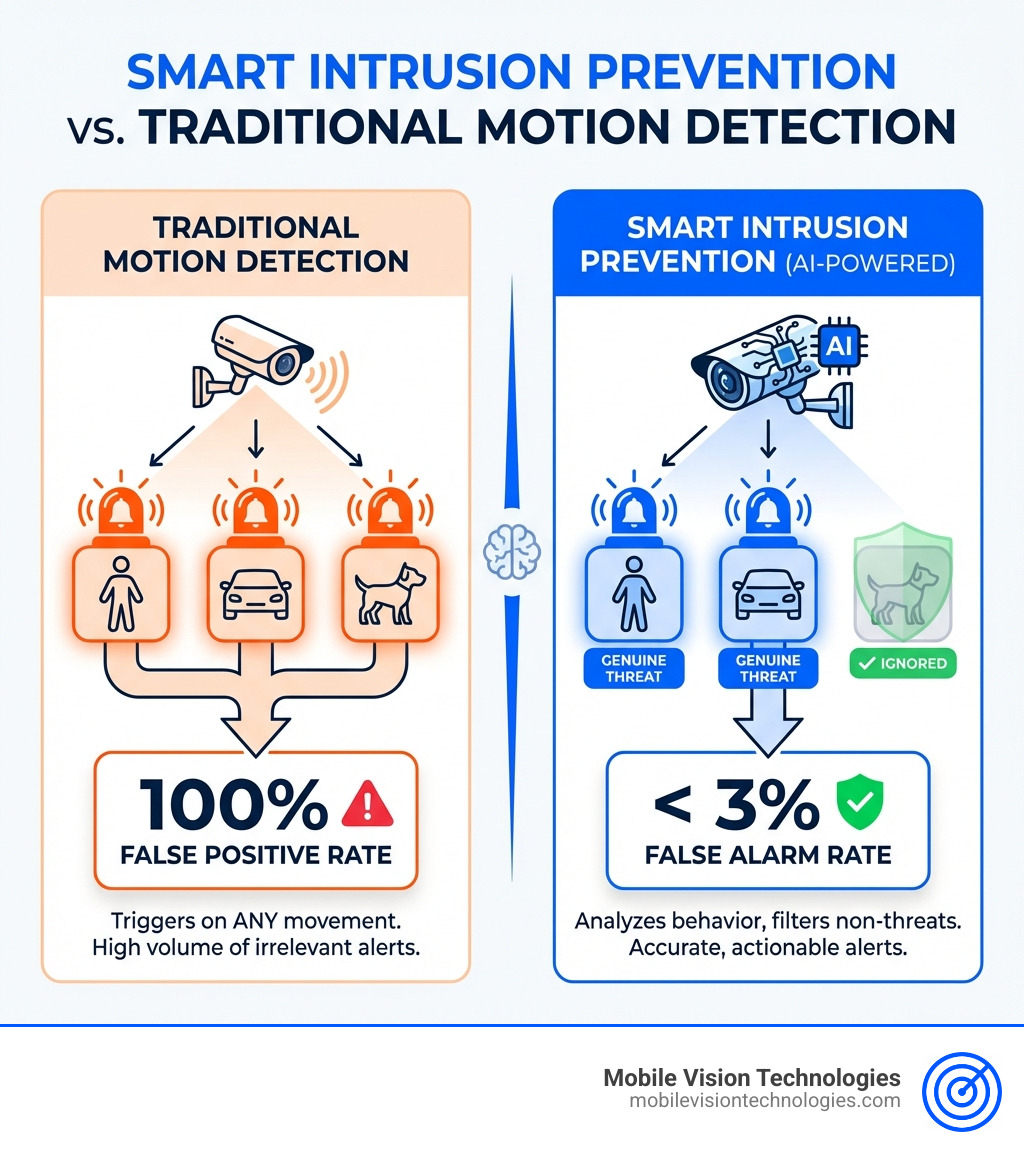
From Reactive to Proactive: Understanding the Evolution of Intrusion Systems
For years, security systems have played a game of catch-up. An event happens, an alarm goes off, and then we react. But with evolving threats, that reactive stance simply isn’t enough. We need to be one step ahead, and that’s where smart intrusion prevention truly shines.
The Limits of Traditional Intrusion Detection
Let’s face it, traditional security methods have their hearts in the right place, but they often fall short in practice. Think about the old-school systems that have been the backbone of security for decades:
- PIR sensors: These Passive Infrared sensors detect changes in heat, which sounds smart, but they’re easily fooled. A stray cat, a gust of wind rustling leaves, or even a sudden change in sunlight can trigger an alarm. We’ve all heard stories of security guards responding to a “major incident” only to find a raccoon rummaging through a dumpster.
- Electric fences: While a strong deterrent, electric fences can’t provide any visual context. They tell you something crossed a boundary, but not what or who. And again, false triggers are a common annoyance.
- Basic video motion detection: This is perhaps the most frustrating. If a camera sees any movement, it triggers an alert. We’re talking about anything from a plastic bag blowing across the parking lot to a tree branch swaying in the wind. These systems often produce unwanted alarms due to non-target triggers.
The consequence of these limitations? High false alarm rates. These aren’t just minor inconveniences; they lead to wasted resources, with security personnel constantly responding to non-threats. Over time, this creates security personnel fatigue, where legitimate alerts might be ignored because they’re buried under a mountain of false positives. Imagine spending hours sifting through footage, only to find nothing. This also results in an inability to retrieve events efficiently, as significant storage space is consumed by irrelevant recordings, making it difficult to locate actual incidents when they occur.
What is Smart Intrusion Prevention?
Now, let’s talk about the game-changer: smart intrusion prevention. This is where artificial intelligence (AI) steps in to revolutionize security. At its core, smart intrusion prevention is an AI-powered analysis system that moves beyond simple motion detection to offer truly proactive defense.
Instead of just detecting movement, these systems use advanced object recognition to understand what is moving. This means differentiating humans and vehicles from other objects. For example, it would not trigger an alarm when it sees a stray dog, a squirrel, or even a tumbleweed blowing across your property in Germantown, TN. The system is intelligent enough to ignore non-threats like animals, sudden weather effects (rain, snow), or changes in light that used to plague older systems.
Our Alarm & Intrusion Detection solutions leverage this sophisticated AI to ensure that when an alert goes off, it’s for a genuine threat. This precision significantly reduces false alarms, allowing our teams and your security personnel to focus on what truly matters.
| Feature | Traditional Intrusion Detection | Smart Intrusion Prevention |
|---|---|---|
| Response | Reactive | Proactive |
| False Alarms | High (often >50%) | Low (typically <3%) |
| Detection Basis | Simple motion, heat | AI-powered object recognition, behavioral analysis |
| Threat Context | Minimal, requires human review | Rich, identifies specific threats (people, vehicles) |
| Retrieval Efficiency | Slow, manual search | Fast, filter by target type |
| Resource Impact | High (wasted responses, storage) | Low (focused responses, efficient storage) |
The ‘Smart’ Engine: AI, Machine Learning, and Core Technologies
The magic behind smart intrusion prevention isn’t magic at all; it’s cutting-edge technology. These systems are intelligent because they are powered by sophisticated AI and machine learning capabilities that allow them to “think” and “learn” about what constitutes a real threat.
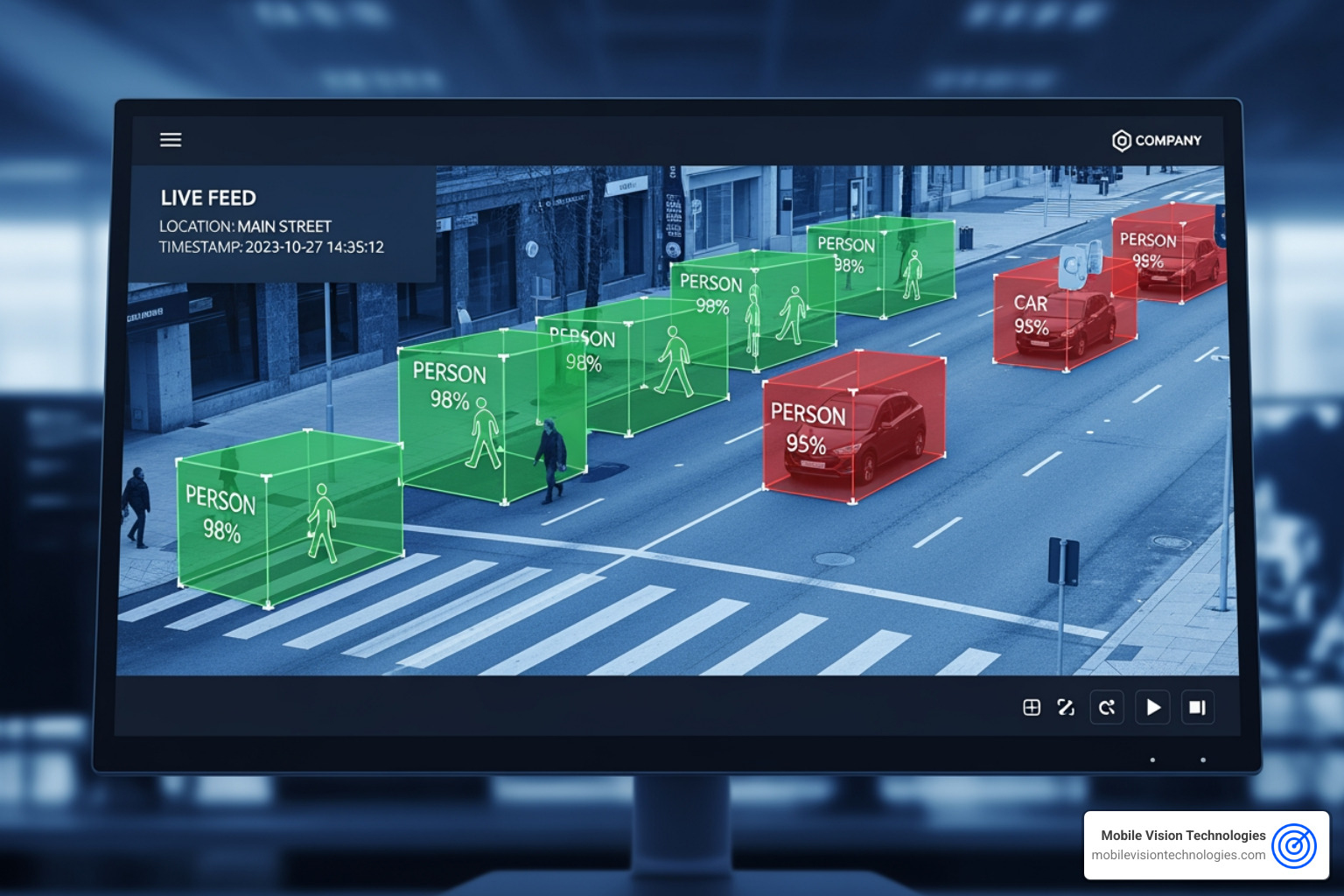
How AI and Machine Learning Deliver High Accuracy
At the heart of every smart intrusion prevention system is a powerful AI engine, often employing anomaly-based detection methods. This means the system uses artificial intelligence and machine learning to create and continually refine a baseline model of normal activity for your specific environment. Imagine an AI learning the typical flow of traffic in your Memphis parking lot or the routine operations inside your Olive Branch warehouse. The system then compares ongoing activity to this model, and when it finds deviations – something that doesn’t fit the “normal” pattern – it responds.
This behavioral analysis is crucial. Rather than just looking for a specific signature of an attack, it identifies attack-like activities. This allows for superior target classification, distinguishing between a delivery truck making a legitimate drop-off and an unauthorized vehicle attempting to breach a perimeter. Deep learning algorithms are particularly effective here, processing millions of data points in milliseconds to identify never-before-seen malicious traffic without relying solely on predefined signatures.
One of the most significant benefits is the drastically reduced false positives. While anomaly-based systems can sometimes flag benign activity, continuous refinement of the baseline model minimizes these occurrences. The goal is an improved threat identification process with an impressively low false alarm rate of less than 3%. This level of accuracy ensures that when an alert is generated, it genuinely indicates a potential security incident, from a curious passerby to a determined intruder. This is a huge leap from traditional systems that might trigger on a squirrel, but it’s also how we protect against sophisticated threats that might otherwise evade detection. To learn more about the technical underpinnings, you can explore what an Intrusion Prevention System (IPS) is.
Integration with Security Infrastructure
One of the most common questions we hear is, “Do I need to rip out all my existing cameras?” The good news is, often, no! Our smart intrusion prevention solutions are designed with flexibility in mind.
It is possible to use a regular surveillance camera without built-in AI and still enjoy the full protection of smart intrusion prevention thanks to NVR-side AI capabilities. This means the intelligence isn’t necessarily housed in the camera itself, but in the Network Video Recorder (NVR) or Video Management System (VMS) that processes the video feed. This allows for upgrading existing systems with advanced AI analytics, making it a highly cost-effective solution for businesses in Bartlett, TN, or Jackson, TN, looking to improve their security without a complete overhaul.
Our systems are built for seamless VMS integration and centralized management. Whether you’re upgrading a few cameras or deploying a comprehensive new system, we ensure it integrates smoothly with your current setup. This approach allows for scalability and consistent policy management across all your security points, providing a unified and robust defense. For a deeper dive into the broader context of IDPS, the Guide to Intrusion Detection and Prevention Systems (IDPS) from NIST offers comprehensive insights.
Key Benefits: Solving Critical Security Challenges
The shift to smart intrusion prevention isn’t just about fancy technology; it’s about solving real-world security problems that plague businesses every day. From reducing costly false alarms to streamlining investigations, the benefits are tangible and impactful.
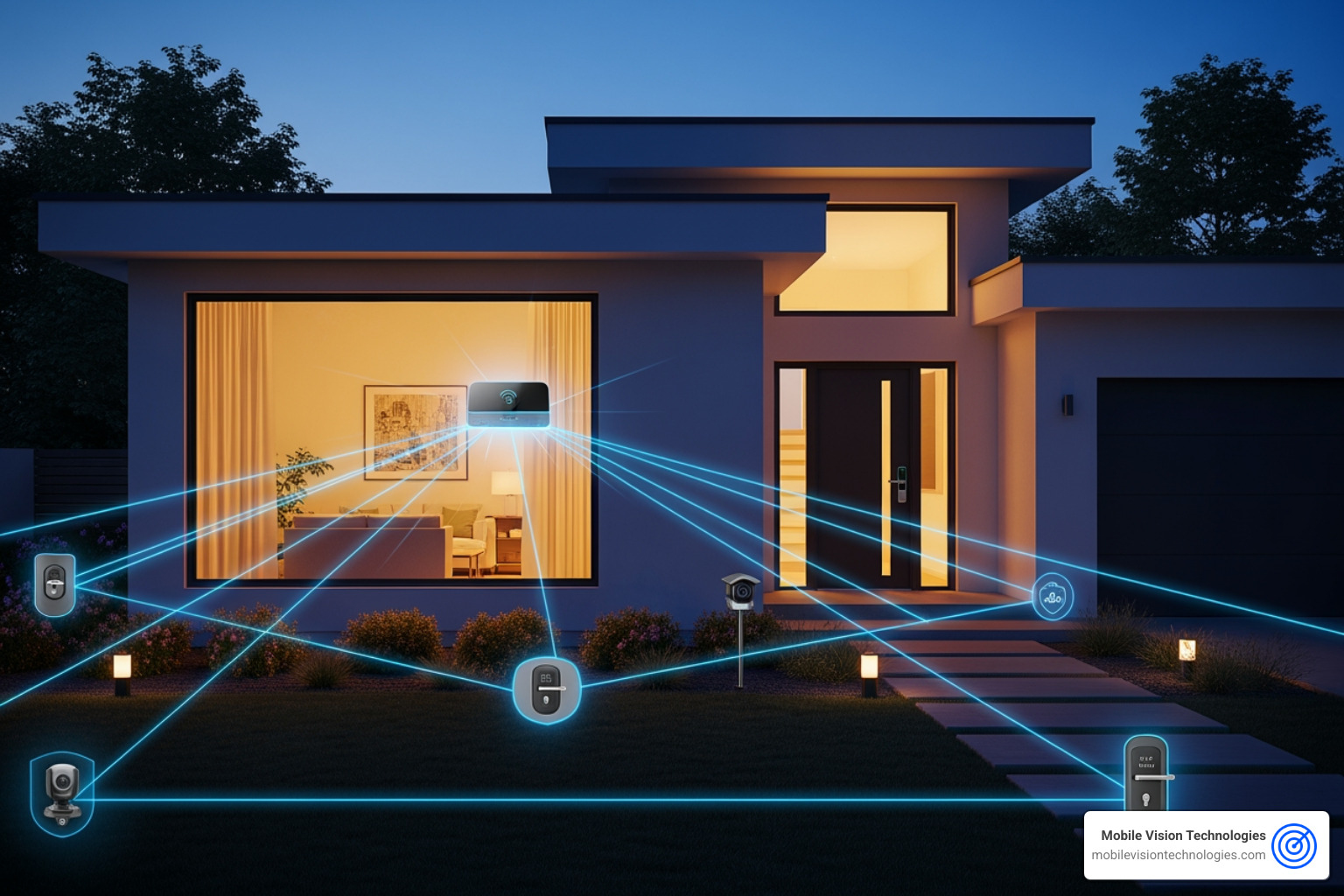
Drastically Reduce False Alarms and Focus on Real Threats
Imagine a security team that only responds to genuine threats. That’s the promise of smart intrusion prevention. By intelligently filtering irrelevant alerts caused by animals, environmental changes, or even just shadows, these systems drastically reduce false alarms to less than 3%. This is a monumental improvement from traditional systems where false alarms can be as high as 50% or more.
This precision saves security personnel countless hours of chasing non-existent threats. Instead of becoming desensitized to constant alerts, they can trust the system to deliver high-fidelity warnings. This improved response effectiveness means faster, more focused action when a real incident occurs. For instance, data from various deployments shows a significant impact: a 70% decrease in overall incidents, a 62% reduction in high-risk crimes, a 43% decrease in trespassing, and even a 13% decrease in the overall crime rate. These statistics highlight how focusing on genuine intrusions empowers security teams to be far more effective in protecting your assets and personnel.
Achieve Efficient Retrieval and Investigation
One of the hidden costs of traditional surveillance is the time spent on investigation after an incident. Locating a specific event in hours or days of footage can be like finding a needle in a haystack. With smart intrusion prevention, that frustration becomes a thing of the past.
Our systems enable efficient retrieval by allowing users to quickly and accurately locate information during playback. Instead of scrubbing through endless video, you can filter recordings by target type (e.g., “show me all events where a person was detected”), time, and even specific channels. This significantly reduces searching time, allowing your team to pinpoint critical moments in minutes, not hours. This provides actionable evidence swiftly for law enforcement or internal review, changing the investigation process. To explore how our comprehensive offerings contribute to this, visit our Services page.
Putting Smart Intrusion Prevention to Work: Applications and Features
The versatility of smart intrusion prevention means it can be deployed in a wide array of settings, offering robust protection where it’s needed most. From construction sites to parking lots, this technology provides eyes and intelligence far beyond human capabilities.
Common Application Scenarios for Smart Intrusion Prevention
Our geographic footprint in Memphis, TN, Southaven, MS, and surrounding areas means we see a diverse range of security needs. Smart intrusion prevention is perfectly suited for these environments:
- Perimeter protection: Guarding fences, property lines, and entry points at warehouses and factories in Olive Branch, MS, to deter and detect unauthorized access.
- Sterile zones: Monitoring sensitive areas within facilities where access is highly restricted.
- Property protection: Securing outdoor assets, equipment, and materials at sites like construction projects in Lakeland, TN, or equipment yards. Case studies have shown how this technology can lead to a 62% reduction in high-risk crimes and a 70% decrease in incidents in these scenarios.
- Business security: From retail locations in Germantown, TN, dealing with grab-and-go theft (which can see a 69% reduction) to multi-location businesses, ensuring overall safety and preventing unauthorized activity.
Here are some specific applications where we’ve seen immense success:
- Warehouse Security Systems & Industrial Mobile Surveillance: Protecting valuable inventory and equipment from theft and vandalism.
- Construction Site Surveillance Systems Memphis TN: Monitoring large, often remote, and dynamic sites to prevent theft of materials and equipment, which is a major concern.
- Parking Lot Security Cameras Memphis TN & Mobile Surveillance Solutions: Ensuring vehicle and personal safety, deterring car break-ins, and preventing loitering.
Key Features of a Modern Solution
When considering a smart intrusion prevention solution, we recommend looking for a comprehensive suite of features that provide both detection and deterrence:
- Real-time alerts and mobile notifications: Immediate alerts sent directly to your phone or monitoring station, ensuring rapid response to genuine threats.
- Remote deterrence: The ability to activate strobe lights, loudspeakers with pre-recorded messages, or even two-way audio to warn off intruders remotely. Imagine telling someone to “Please leave the property, you are being recorded” from your phone, before they even get close to the building.
- High-resolution cameras: Clear, detailed footage is essential for accurate AI analysis and for providing undeniable evidence.
- Low-light performance: Advanced sensors, including thermal imaging or infrared (IR) cameras, can detect threats even in total darkness, ensuring 24/7 vigilance.
- Mobile surveillance capabilities: For flexible deployment, especially at temporary sites or areas without existing infrastructure, our Mobile Video Surveillance units are ideal.
Frequently Asked Questions about Smart Intrusion Prevention
We often get asked similar questions about this powerful technology. Let’s address some of the most common ones.
Can I use my existing cameras with a smart system?
Absolutely! This is one of the most cost-effective aspects of upgrading to smart intrusion prevention. You don’t necessarily need to replace all your existing cameras. Thanks to NVR-side AI capabilities, the intelligence can be added at the recording device level. This means a standard surveillance camera can feed its video stream to an NVR equipped with AI analytics, allowing you to enjoy the full protection of smart intrusion prevention. This approach is fantastic for upgrading system intelligence and protecting your existing investments.
How does this technology improve operational efficiency?
Smart intrusion prevention dramatically improves operational efficiency in several ways:
- Reduces time spent on false alarms: Security personnel are no longer wasting time investigating non-threats, freeing them up for more critical tasks.
- Speeds up investigations: As we discussed, efficient retrieval capabilities mean incidents can be reviewed and evidence gathered much faster.
- Allows for remote monitoring: With mobile notifications and remote deterrence, security teams can manage sites from anywhere, reducing the need for constant physical patrols.
- Frees up security staff for other tasks: By automating the initial detection and filtering of irrelevant events, human security staff can focus on proactive patrolling, maintenance, or other essential duties.
What is the difference between an IDS and an IPS?
This is a great question, and the terms are often used interchangeably, but there’s a crucial distinction:
- IDS (Intrusion Detection System): Think of an IDS as a vigilant watchdog that barks when it sees something suspicious. It’s a passive monitoring system that detects threats and alerts you. It identifies potential security breaches or policy violations but doesn’t take action to stop them.
- IPS (Intrusion Prevention System): An IPS, on the other hand, is like that same watchdog, but it also has the ability to chase the intruder away. It’s an active system that not only detects threats but also takes automated actions to prevent them in real-time. This could involve blocking malicious traffic, dropping suspicious packets, or even reconfiguring a firewall. IPS solutions actively work to stop threats before they can cause harm.
While both are vital components of a robust security strategy, the “prevention” aspect of an IPS is what makes it a more proactive and powerful tool in stopping incidents before they escalate.
Conclusion: Secure Your Future with Intelligent Protection
The world of security is constantly evolving, and so must our approach to protecting our businesses and properties. Traditional, reactive security measures are simply no longer sufficient in the face of increasingly sophisticated threats. Smart intrusion prevention offers a powerful, proactive solution that leverages the best of AI and machine learning to deliver unparalleled accuracy and efficiency.
By drastically reducing false alarms, enabling lightning-fast event retrieval, and providing real-time, intelligent deterrence, smart intrusion prevention transforms security from a constant battle of catch-up into a strategic, forward-looking defense. It allows businesses in places like Memphis, TN, and Southaven, MS, to protect their assets with confidence, knowing that their security systems are working smarter, not just harder.
At Mobile Vision Technologies, we pride ourselves on combining advanced IoT expertise with traditional security experience to offer flexible, full-service protection that truly makes a difference. We believe in stopping crime before it starts, and smart intrusion prevention is a cornerstone of that philosophy.
Ready to upgrade your security and experience the peace of mind that comes with intelligent protection? Contact Us today to discuss your specific needs. Take the next step in securing your assets by exploring our advanced AI-Powered Video Surveillance solutions.