
Wireless Intrusion Detection: Essential 2026 Guide
What is Wireless Intrusion Detection?
When you search for wireless intrusion detection, you’re looking to understand how to protect your wireless networks from hidden dangers. Here’s a quick overview of what a Wireless Intrusion Detection System (WIDS) does:
- Monitors wireless network activity for unusual or malicious patterns.
- Detects unauthorized access points, intrusion attempts, and vulnerabilities.
- Identifies threats transmitted over wireless channels, even those not connected to your main network.
- Alerts security teams in real-time about suspicious signals or devices.
In today’s world, wireless technology is everywhere. From our homes to vast corporate campuses, Wi-Fi and other wireless connections power nearly everything. This convenience, however, comes with significant security risks.
The number of wireless connections worldwide is set to reach 19.8 billion. More than half of businesses now use IoT devices. With so many devices broadcasting signals, your network becomes a prime target for hidden threats.
A wireless intrusion detection system acts as your digital sentry. It constantly watches the airwaves, looking for anything out of place. This guide will walk you through everything you need to know about these vital security tools.
As Chris Edens, I’ve dedicated my career to protecting people through technology, and I understand the critical role wireless intrusion detection plays in modern security. My experience with mobile surveillance and AI technologies helps me build robust defenses, even for the most challenging environments.
What is a Wireless Intrusion Detection System (WIDS) and Why is it Essential?
A Wireless Intrusion Detection System (WIDS) is a security solution that detects anomalies, intrusions, and vulnerabilities in a wireless network. It acts as a guardian, scanning radio frequencies for threats by monitoring packet patterns and behaviors. As businesses in Memphis, TN, and Southaven, MS, increasingly rely on wireless and IoT devices, networks become prime targets for cyberattacks, making a WIDS an essential security component.

A WIDS provides crucial benefits that make it indispensable:
- Improved Wireless Security: Provides a dedicated defense layer for wireless infrastructure, catching threats that wired systems miss.
- Improved Network Visibility: Offers a clear view of all wireless activity, revealing unknown devices and connections.
- Proactive Threat Management: Enables swift response to real-time threats, preventing significant damage.
- Internal and External Threat Protection: Catches both external attackers and internal threats from unauthorized devices.
- Regulatory Compliance: Helps meet security standards by providing detailed audit logs of network activity.
A WIDS empowers us to enforce our network security policies and maintain a secure operational environment. If you’re looking to bolster your overall security posture, consider exploring our Alarm & Intrusion Detection services, which often work hand-in-hand with wireless detection.
Understanding the Need for Wireless Intrusion Detection
Wireless networks have unique vulnerabilities because their signals travel through the air, exposing them to remote interception and unauthorized access. The need for wireless intrusion detection is critical for the following reasons:
- Invisible Threats: Malicious actors can operate outside the physical perimeter, eavesdropping or injecting harmful traffic.
- Remote Work Risks: The expanding network boundary from remote work increases the risk of attacks through unsecured personal networks.
- BYOD Policies: Personal devices introduced by BYOD policies may lack proper security, creating entry points for malware.
- IoT Device Vulnerabilities: The growing number of IoT devices expands the attack surface, as many have weak or default security settings.
- Data Interception: Attackers can exploit poor encryption or rogue APs to intercept data and steal credentials.
- Unauthorized Access: Anyone within range can potentially gain access, bypassing traditional defenses.
- Policy Enforcement: A WIDS identifies unauthorized devices or activities, helping to enforce security policies.
These factors highlight that traditional wired intrusion detection systems often lack the specialized capabilities needed to combat the evolving landscape of wireless threats.
Specific Threats a WIDS Can Detect
A wireless intrusion detection system is engineered to identify threats that exploit the open nature of radio waves. Here are specific dangers a WIDS can detect:
- Rogue Access Points (APs): Unauthorized APs connected to the network, often installed by employees or attackers. A WIDS detects and locates them.
- Evil Twin Attacks: A rogue AP that mimics a legitimate Wi-Fi network to trick users into connecting, allowing attackers to intercept traffic. A WIDS identifies these deceptive APs.
- Man-in-the-Middle (MITM) Attacks: An attacker intercepts and potentially alters communications between a user and a legitimate access point. WIDS detects the anomalous traffic patterns from these attacks.
- MAC Address Spoofing: An attacker clones a legitimate device’s MAC address to bypass access controls. WIDS uses radio fingerprinting to detect spoofed devices.
- Ad-hoc Networks: Peer-to-peer connections that bypass central access points, which can be used to create unauthorized communication channels.
- Denial-of-Service (DoS) Attacks: Attempts to flood the network with traffic or deauthenticate users. A WIDS identifies attack patterns like deauthentication flooding.
- Misconfigured APs: Legitimate APs with security risks, such as weak encryption or default passwords, which a WIDS can flag.
- Unauthorized Devices: Any device attempting to connect without permission or operating in a secure area can be detected and located.
- Honeypots: Fake access points set up to lure unsuspecting users, which a WIDS can identify.
By continuously monitoring for these specific threats, a WIDS provides a critical layer of defense, safeguarding our wireless networks and the sensitive data they carry.
Core Components and Capabilities of a WIDS
A wireless intrusion detection system’s architecture includes several key components that work together to provide comprehensive security.
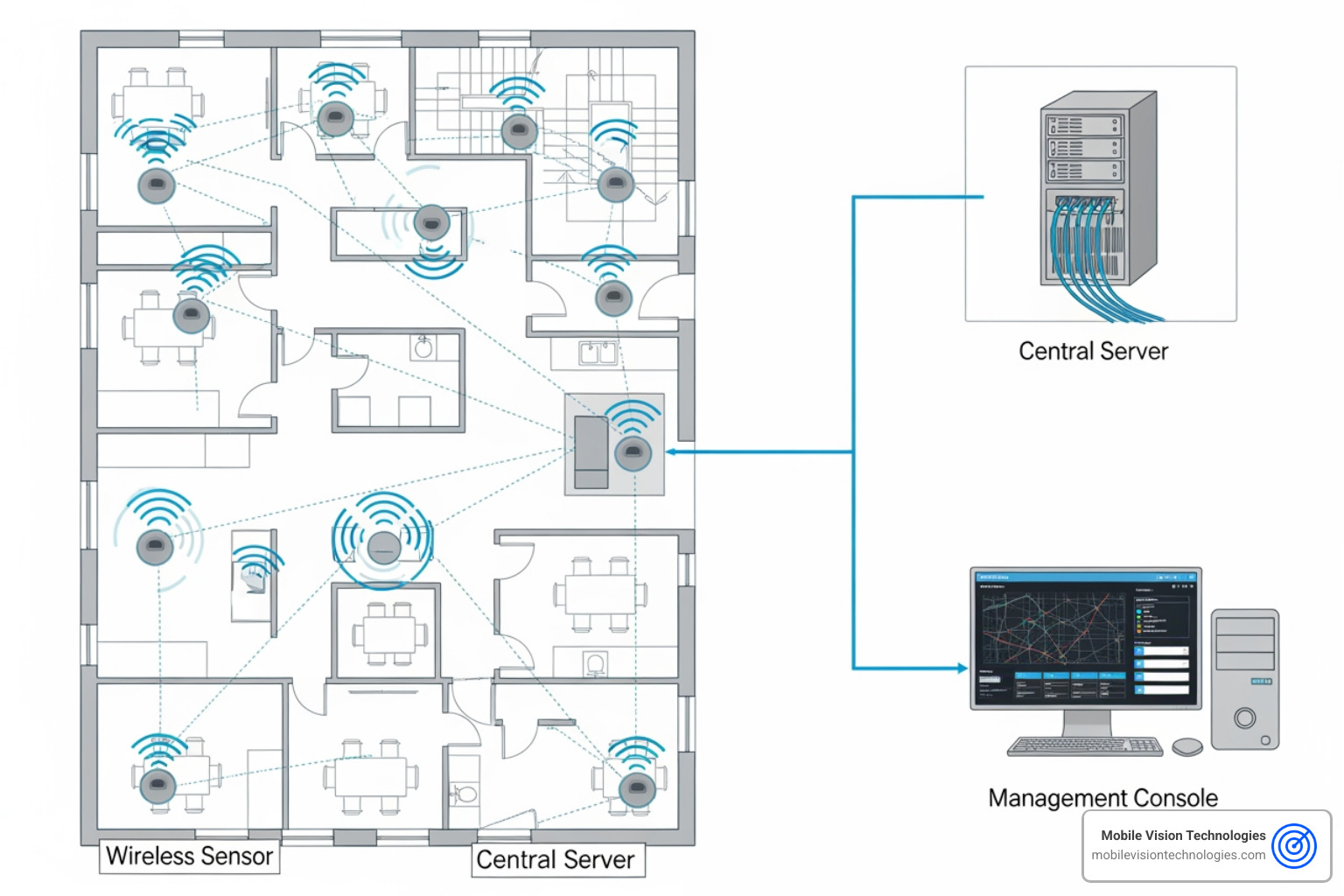
The main components of a WIDS are:
- Sensors (Wireless Probes): Strategically placed devices that continuously monitor the radio spectrum (Wi-Fi, Bluetooth, cellular) and capture raw wireless traffic.
- Centralized Server/Console: The system’s brain, which aggregates sensor data, performs real-time analysis to identify threats, and manages alerts and reports.
- Client Software (Optional): Allows administrators to manage the system, view alerts, and configure policies remotely.
In terms of architecture, WIDS can be implemented in two primary ways:
- Standalone WIDS: Uses dedicated hardware sensors for continuous, full-time monitoring. This offers maximum security and is ideal for high-security or complex environments.
- Integrated WIDS: Builds WIDS functionality into existing Access Points (APs). It’s a cost-effective solution, but APs must split time between serving clients and scanning, which may offer less dedicated monitoring.
Regardless of the architecture, a WIDS provides crucial capabilities like real-time monitoring, threat classification, location tracking, and historical analysis for forensic investigation.
Key Features and Detection Techniques
An effective wireless intrusion detection system uses sophisticated features and detection techniques to distinguish normal activity from potential threats, including:
- Signature-Based Detection: Compares wireless traffic against a database of known attack signatures. It is effective for known threats but requires frequent updates.
- Anomaly-Based Detection: Establishes a baseline of normal network behavior and alerts on deviations. This is crucial for identifying new or zero-day attacks.
- Device Fingerprinting: Analyzes unique radio characteristics to create a device “fingerprint,” helping to identify spoofed MAC addresses.
- Policy Violation Monitoring: Enforces security policies by monitoring for issues like weak encryption or unauthorized device types.
- Automated Alerting: Automatically generates and sends alerts to security teams via email, SMS, or SIEM integration for rapid response.
- Forensic Reporting: Maintains detailed logs of all events for post-incident analysis, compliance audits, and security refinement.
- Encrypted Traffic Analysis Limitations: A WIDS cannot decrypt encrypted traffic payloads but can still identify threats by analyzing metadata, traffic behavior, and attacks on management frames.
By combining these techniques, a WIDS provides a robust defense against a constantly evolving threat landscape, helping us secure our wireless environment.
WIDS vs. WIPS: Detection vs. Prevention
It’s crucial to distinguish between a Wireless Intrusion Detection System (WIDS) and a Wireless Intrusion Prevention System (WIPS). A WIDS is a passive system that detects and alerts on threats, acting as an early warning system. A WIPS is an active system that not only detects threats but also automatically prevents them, for example, by disconnecting a rogue device. The key difference is detection (WIDS) versus active prevention (WIPS).
| Feature | Wireless Intrusion Detection System (WIDS) | Wireless Intrusion Prevention System (WIPS) |
|---|---|---|
| Primary Function | Monitors the radio spectrum for unauthorized activity and alerts. | Monitors the radio spectrum, detects threats, and automatically takes countermeasures. |
| Action Level | Passive: Detects and reports. | Active: Detects, reports, and blocks/contains threats. |
| Alerting | Provides real-time alerts to administrators. | Provides real-time alerts and initiates prevention actions. |
| Containment | Typically none; requires manual intervention or integration with other systems. | Can automatically disconnect rogue devices, deauthenticate attackers, or block access. |
| Interference | Minimal to none with network operations. | Can potentially interfere with legitimate network traffic if misconfigured. |
| Complexity | Generally less complex to deploy and manage. | More complex due to active countermeasures, requiring careful tuning. |
| Use Cases | Compliance monitoring, forensic analysis, gaining visibility into wireless threats. | High-security environments requiring immediate threat neutralization, PCI DSS compliance. |
A WIPS builds on WIDS capabilities by adding automated countermeasures, making it ideal for high-security environments or those requiring immediate threat neutralization, such as for PCI DSS compliance. For a deeper dive, explore resources like the Wireless intrusion prevention system entry on Wikipedia or the Wireless Intrusion Detection & Protection overview from HPE Aruba Networking.
Best Practices for Deploying and Managing a Wireless Intrusion Detection System
Effectively deploying and managing a wireless intrusion detection system requires a thoughtful approach from planning to maintenance. At Mobile Vision Technologies, we follow a structured methodology for businesses in areas like Jackson, TN, and Olive Branch, MS, to ensure optimal performance.
Best Practices for Implementing Wireless Intrusion Detection
Here’s a list of actionable steps and best practices we recommend for implementing a WIDS:
- Assess the Wireless Environment: Conduct a thorough site survey to map existing devices, frequencies, and interference sources to identify vulnerabilities.
- Choose the Right WIDS Type: Select the ideal WIDS (standalone or integrated) based on your security needs, existing infrastructure, and budget.
- Strategically Place Sensors: Deploy sensors to maximize coverage and minimize blind spots, especially in sensitive areas and at the network perimeter.
- Configure Detection Policies: Customize detection policies, including anomaly thresholds and whitelists for authorized devices.
- Test the System Thoroughly: Simulate wireless attacks to verify detection capabilities and ensure alerts function correctly.
- Monitor and Respond to Alerts Promptly: Establish clear protocols for 24/7 monitoring and rapid response to investigate and mitigate threats.
- Regularly Update System Software and Signatures: Keep WIDS software and threat signature databases updated to protect against new attack methods.
- Train Staff: Train personnel on how to interpret alerts and follow incident response procedures.
- Apply Reasonable Security Practices: Combine WIDS with other security measures like strong encryption and regular audits as part of a layered defense.
For comprehensive support in deploying and managing your wireless security, explore our Installation, Maintenance & Monitoring services.
Meeting Compliance and Regulatory Requirements
Wireless intrusion detection is critical for helping businesses in regulated industries meet stringent requirements for data protection and network security.
- PCI DSS: Mandatory for businesses handling credit card data. The PCI Security Standards Council recommends WIPS for automated scanning, as detailed in their “PCI DSS Wireless Guidelines”. A WIDS provides the monitoring and audit trails needed for compliance.
- DoD Mandates: Department of Defense (DoD) mandates require continuous electronic device detection in secure facilities. Modern WIDS solutions can meet these federal requirements with precise, continuous threat detection.
- HIPAA: Healthcare providers must protect electronic Protected Health Information (ePHI). A WIDS helps secure wireless networks and provides the necessary audit trails to demonstrate compliance.
- SOX (Sarbanes-Oxley Act): Publicly traded companies must maintain internal controls over financial reporting. A WIDS helps secure the network infrastructure that supports financial data, contributing to SOX compliance.
Audit Logs and Data Protection: A key WIDS feature for compliance is its ability to generate detailed audit logs. These logs record all detected events, providing invaluable documentation for regulatory audits and demonstrating a commitment to data protection.
How WIDS Fits into a Broader Cybersecurity Strategy
A wireless intrusion detection system is most effective when integrated into a broader, layered cybersecurity strategy. It is an essential piece of a holistic defense mechanism for your business.
- Layered Security: In a defense-in-depth approach, a WIDS forms a critical layer for wireless vulnerabilities, complementing firewalls, endpoint protection, and wired Intrusion Detection Systems (IDS).
- Zero-Trust Architecture: A WIDS aligns with the Zero-Trust model—where no device is inherently trusted—by continuously verifying the legitimacy of all wireless devices and connections.
- SIEM Integration: Integrating WIDS alerts with a Security Information and Event Management (SIEM) platform centralizes security data, helping teams correlate events and streamline incident response.
- Automated Response: While a WIDS primarily detects, integrating it with automation tools or a WIPS can trigger automated actions, such as isolating a compromised device or blocking a malicious MAC address.
- Future Trends: AI and Machine Learning: The future of wireless intrusion detection is driven by AI and Machine Learning (ML), which help WIDS adapt to new attacks, reduce false positives, and identify subtle anomalies. This aligns with our expertise in AI-Powered Video Surveillance.
By integrating WIDS with other security systems like Access Control Systems, we create a unified security posture. This ensures that whether a threat is digital or physical, our systems work together to provide comprehensive protection for businesses in Jackson, TN, Germantown, TN, and beyond.
Frequently Asked Questions about Wireless Intrusion Detection
We often get questions about how wireless intrusion detection systems handle various scenarios. Here are answers to some of the most common inquiries.
Can a WIDS detect threats on encrypted Wi-Fi networks?
Yes. While a WIDS cannot decrypt the content (payload) of traffic on encrypted networks like WPA2 or WPA3, it can still effectively detect threats. It does this by analyzing unencrypted metadata, traffic patterns, and behavior. For example, a WIDS can identify unusual spikes in data transfer, connections to unauthorized devices, or attacks that manipulate Wi-Fi management and control frames, which are often unencrypted. It acts like a detective observing suspicious behavior without needing to know the content of the conversation, providing critical security insights even in encrypted environments.
What is the difference between a standalone and an integrated WIDS?
The main difference is their hardware and operational focus.
- Standalone WIDS: Uses dedicated hardware sensors whose only job is to monitor the wireless spectrum 24/7. This provides maximum security and performance, making it ideal for high-security environments or large enterprises. However, it requires a separate investment in hardware and management.
- Integrated WIDS: Builds WIDS functionality directly into existing wireless Access Points (APs). This is a cost-effective solution for small to medium-sized businesses as it uses existing hardware. The trade-off is that the APs must split their time between providing Wi-Fi service and scanning for threats, which may result in less comprehensive monitoring than a standalone system.
In short, a standalone system offers dedicated, full-time security, while an integrated system provides a more budget-friendly option by adding security functions to existing network hardware.
How does a WIDS handle false positives?
Handling false positives—legitimate activity incorrectly flagged as a threat—is crucial for any WIDS. Effective management prevents “alert fatigue” and ensures security teams can focus on real threats. Key strategies include:
- Tuning and Whitelisting: The most effective method is to properly configure the system by fine-tuning detection rules and creating a “whitelist” of all authorized wireless devices. This tells the WIDS what is normal and safe, allowing it to ignore legitimate traffic.
- Setting Baselines: For anomaly-based detection, we carefully establish a baseline of normal network behavior. By setting appropriate thresholds, we can reduce alerts from minor, harmless deviations.
- Regular Review and Adjustment: The wireless environment is always changing. We regularly review alerts to identify patterns of false positives and adjust the system’s configuration, rules, and whitelists over time to improve accuracy.
By combining these techniques, we can significantly reduce false positives and ensure that alerts are both relevant and actionable.
Conclusion
In an era where wireless connectivity is fundamental to business, the importance of robust wireless intrusion detection is clear. A Wireless Intrusion Detection System (WIDS) acts as a vigilant guardian, monitoring for threats like rogue access points and man-in-the-middle attacks to provide critical visibility and early warnings. Proper implementation, continuous monitoring, and adherence to best practices are essential for maximizing its effectiveness and meeting regulatory compliance.
A WIDS is a strategic component of a broader cybersecurity framework. Integrating it with layered security, Zero-Trust principles, and SIEM platforms creates a resilient defense against an ever-changing threat landscape.
At Mobile Vision Technologies, we combine advanced IoT expertise with traditional security experience to offer flexible, full-service protection. By integrating WIDS with other security layers like mobile surveillance and access control, businesses can create a robust defense against both digital and physical intrusions. For a complete security solution that protects your assets in real-time, explore our Mobile Video Surveillance services.