
Your Blueprint for an AI Surveillance System Project
Changing Security: The Power of AI Surveillance
An ai surveillance system project aims to move beyond simple recording, bringing intelligence and automation to security operations. This shift helps protect your assets and people more effectively than ever before.
Here’s what an AI surveillance system project typically involves:
- Intelligent Object Detection: Automatically identifies people, vehicles, and specific objects.
- Behavioral Analysis: Detects unusual activities or suspicious patterns in real-time.
- Real-time Alerts: Sends instant notifications to security personnel for immediate action.
- Automated Response: Can trigger alarms, lights, or even verbal warnings without human input.
- Data Analytics: Provides valuable insights for improving overall security strategies.
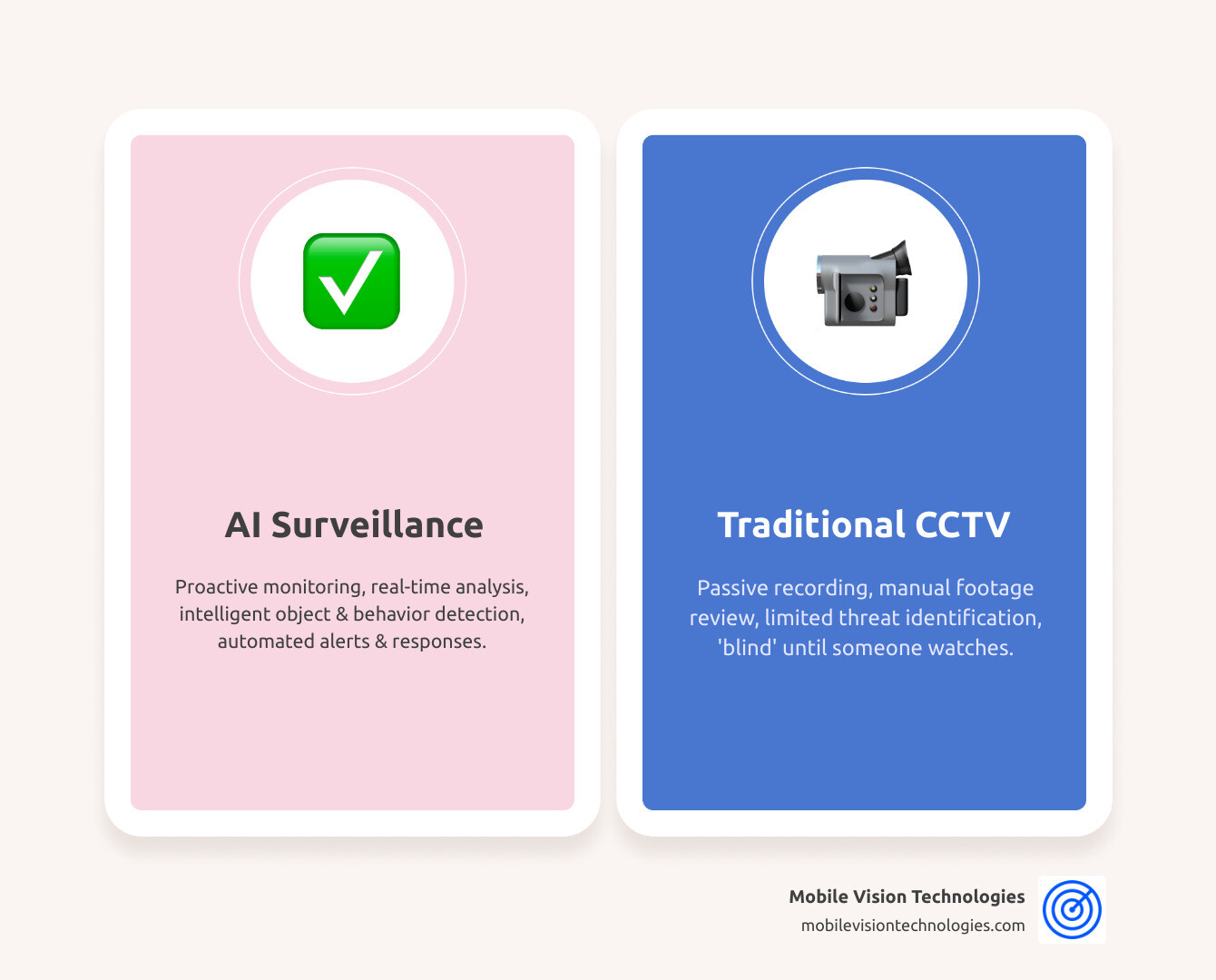
Traditional CCTV systems are often “blind” until someone reviews the footage. As one expert noted, “Human operators get tired. Cameras don’t. But without AI, CCTV systems stay _blind_ until someone watches the footage.” This highlights the need for AI to improve threat detection, reduce the workload on personnel, and enable faster responses to incidents.
With years of experience protecting people, Chris Edens specializes in leveraging advanced technology for security. His expertise in mobile surveillance and cutting-edge AI makes him a leading voice in any ai surveillance system project.
Planning Your AI Surveillance System Project
Starting on an ai surveillance system project is an exciting endeavor that blends cutting-edge technology with practical security needs. But before we dive into the nuts and bolts, let’s explore why we might choose this path and what foundational decisions we need to make.
Our primary motivations for developing an AI surveillance system often stem from a desire for improved security, greater control, and smarter monitoring. We might prioritize data privacy, preferring to keep video feeds captured around our properties private. Customization is another key driver – perhaps we need a system that can differentiate between family members and strangers, or even one that monitors wildlife activity. Imagine a system that alerts us to an unexpected visitor or captures a rare glimpse of local fauna!
The hardware we choose forms the backbone of our system. For DIY projects, single-board computers (SBCs) like the Raspberry Pi 5 and NVIDIA Jetson series are popular choices. The Raspberry Pi 5, with its improved processing power, is excellent for running convolutional neural networks (CNNs) directly on the device. For more demanding AI tasks or if we plan to extend our system with advanced features like conversation or simultaneous localization and mapping (SLAM), the NVIDIA Jetson Orin Nano could be a powerful, albeit potentially “overkill” option for a vision-only security camera.
When selecting AI vision models for these edge devices, we face a crucial trade-off between accuracy, speed, and model size. Lightweight models are essential for efficient processing on resource-constrained hardware. YOLO (You Only Look Once) variants like YOLOv8 or YOLOv5-Tiny are celebrated for their real-time inference capabilities. MobileNet-SSD offers a good balance, while EfficientDet-Lite is often considered highly accurate for diverse object detection, with official TensorFlow Lite support for optimized deployment. We can even Download the EfficientDet-Lite model from Kaggle to get started.
Here’s a quick comparison of popular hardware choices for our ai surveillance system project:
| Feature | Raspberry Pi 5 | NVIDIA Jetson |
|---|---|---|
| Processing Power | Good for CNNs on edge | Excellent for advanced AI, dedicated GPU |
| Cost | More affordable | Higher, especially for higher-end models |
| Ease of Use | Very user-friendly, large community support | More complex, specialized ecosystem |
| Power Needs | Lower | Higher |
| Typical Use | DIY security, home automation, basic AI | Robotics, advanced computer vision, complex AI |
Choosing the Right Hardware
Our journey into building an ai surveillance system project begins with selecting the right hardware. The Raspberry Pi 5 stands out as a powerful and accessible option, offering significant computational improvements over its predecessors, making it well-suited for on-device AI inference. We’ll typically pair it with a Raspberry Pi camera module, connecting via the Camera Serial Interface (CSI) port. A high-speed MicroSD card (8GB or higher, preferably 32GB or more, Class 10) is crucial for the operating system and storing our AI models and captured data. Don’t forget a reliable power supply to keep everything running smoothly.
For those requiring even more processing power, perhaps for complex multi-stream analysis or when integrating other sensors, NVIDIA Jetson devices (like the Jetson Nano or Xavier AGX) offer dedicated GPUs that excel at parallel processing for deep learning. While they come with a higher price tag and a steeper learning curve, they open up capabilities that might be out of reach for a Raspberry Pi.
No matter our choice, proper setup is key. For comprehensive security solutions, including the installation and ongoing care of our hardware, we can always find More info about Installation, Maintenance & Monitoring.
Selecting an AI Vision Model
The “brain” of our ai surveillance system project lies in its AI vision model. These models, primarily focused on object detection, enable our system to “see” and understand what’s happening in the video feed. For edge devices, we often look at models like YOLOv8, MobileNet-SSD, and EfficientDet-Lite.
- YOLO (You Only Look Once): Famous for its speed, YOLO variants (like YOLOv8 or the even lighter YOLOv5-Tiny/Nano) are excellent for real-time applications where quick detection is paramount. They can identify multiple objects in an image with a single pass.
- MobileNet-SSD (Single Shot MultiBox Detector with MobileNet backbone): This model offers a good balance between speed and accuracy, optimized for mobile and embedded vision applications.
- EfficientDet-Lite: While potentially a bit slower than some YOLO variants, EfficientDet-Lite often boasts higher accuracy, especially when detecting a diverse range of objects. It’s designed to be efficient across various scales.
When choosing, we consider:
- Model Size: Smaller models consume less storage and memory on our edge device.
- Inference Speed: How many frames per second (FPS) the model can process. For real-time monitoring, higher FPS is better.
- Accuracy: How correctly the model identifies and localizes objects.
To optimize these models for edge devices, techniques like quantization are invaluable. Quantization can significantly shrink a model’s size and reduce its computational demands by using lower-precision numbers (e.g., 16-bit or 8-bit integers instead of 32-bit floating points) with only a minimal drop in accuracy. Many pre-trained models are available, often trained on vast datasets like COCO, which includes 330K images and 1.5 million object instances.
Building the System: Software and Assembly
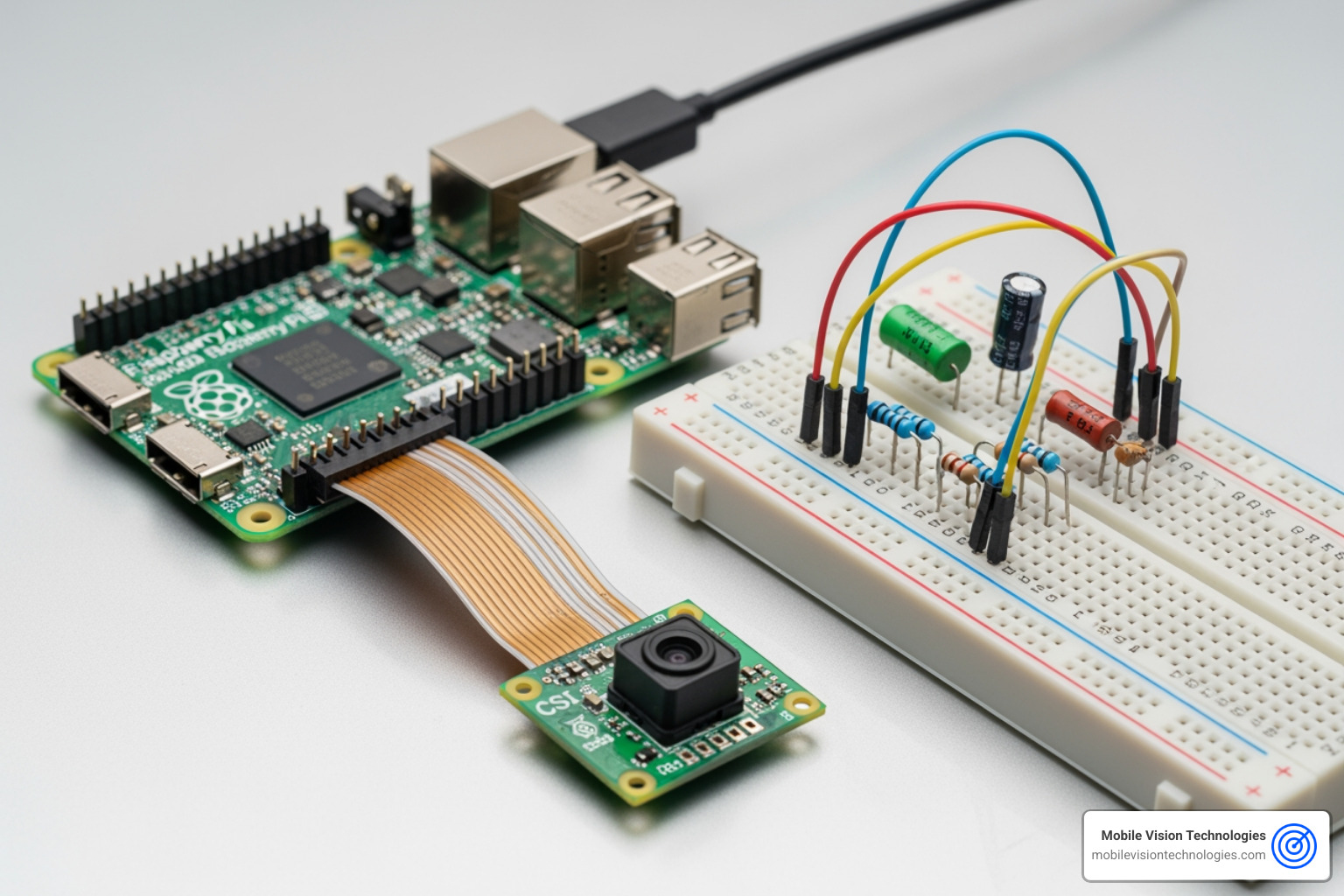
With our hardware selected and our AI model chosen, it’s time to bring our ai surveillance system project to life through software and physical assembly. This stage involves setting up the development environment, integrating video streams, and housing our creation in a functional enclosure.
Essential Software for Your AI Surveillance System Project
Setting up the software environment correctly is a critical step. We’ll typically begin by installing Python, the language of choice for most AI and machine learning projects. For those starting from scratch, we can find detailed instructions on How to install Python3. Once Python is in place, creating virtual environments (venv) is a best practice. This isolates our project’s dependencies, preventing conflicts and ensuring reproducibility.
Within our virtual environment, we’ll install essential libraries:
- OpenCV: This open-source computer vision library is indispensable for video processing, capturing frames from our camera, and drawing bounding boxes around detected objects.
- PyTorch or TensorFlow: Depending on our chosen AI model, we’ll need one of these deep learning frameworks to load and run our models.
- Flask: For creating a web interface to view live feeds, manage settings, and visualize data, Flask is a lightweight and popular Python web framework.
- Ultralytics and Supervision: If we’re using YOLOv8, these libraries provide streamlined tools for object detection and visualization.
- SQLAlchemy: For database management, especially if we’re storing detection logs or attendance records, SQLAlchemy offers an object-relational mapper for Python.
- InfluxDB: For time-series data like logging detection events and timestamps, InfluxDB is a robust choice.
For handling video streams from our Raspberry Pi camera, the picamera2 library is the native and recommended solution, offering efficient video capture and encoding. We can Learn more about the picamera2 framework to understand its capabilities. For generic webcams, OpenCV provides robust capture functionalities. Both facilitate getting frames to our AI model for inference.
Finally, for deployment and management, Docker is a game-changer. It allows us to package our application and all its dependencies into a consistent, isolated environment. This ensures that our ai surveillance system project runs reliably across different machines and simplifies setup significantly. We can define our environment, build a Docker image, and then run it with ease, isolating our surveillance application from the host system. This consistency and ease of use are invaluable, especially when deploying on multiple devices or managing updates.
Assembling a Custom Camera Enclosure
While off-the-shelf enclosures exist, a custom 3D-printed enclosure offers unparalleled flexibility for our ai surveillance system project. It allows us to perfectly fit our chosen hardware, integrate mounting points, and even add features like lens mounts or ventilation.
The process typically involves:
- Designing/Downloading STL Files: We can design our own parts using CAD software or download pre-existing STL files. For example, we might need a backplate, base mount, bottom, lens mount, and top for our camera. Download an example camera backplate STL file to get an idea of what these files look like.
- 3D Printing: Using a 3D printer, we’ll print each component. Recommended infill percentages might vary; for general parts, 20% is often sufficient, while parts requiring more strength, like a holder, might benefit from 50% infill.
- Assembly Steps:
- Mounting the Board: Secure our Raspberry Pi or Jetson board within the enclosure. Hot glue can be surprisingly effective for securing boards if screw holes aren’t perfectly aligned.
- Securing the Camera: Mount the camera module into its designated slot, often a lens mount component, ensuring the ribbon cable is correctly routed.
- Cable Management: Route power cables and any other necessary wiring neatly to avoid interference and ensure a clean build.
- Final Assembly: Join the printed parts together using small screws (e.g., M3 or M4) and sometimes a bit of adhesive. We might need to ream out screw holes with a small drill bit (1/8 inch or 2.5mm) for a perfect fit.
This hands-on approach ensures our camera is protected, aesthetically pleasing, and perfectly custom to our ai surveillance system project.
Implementing Core AI Capabilities
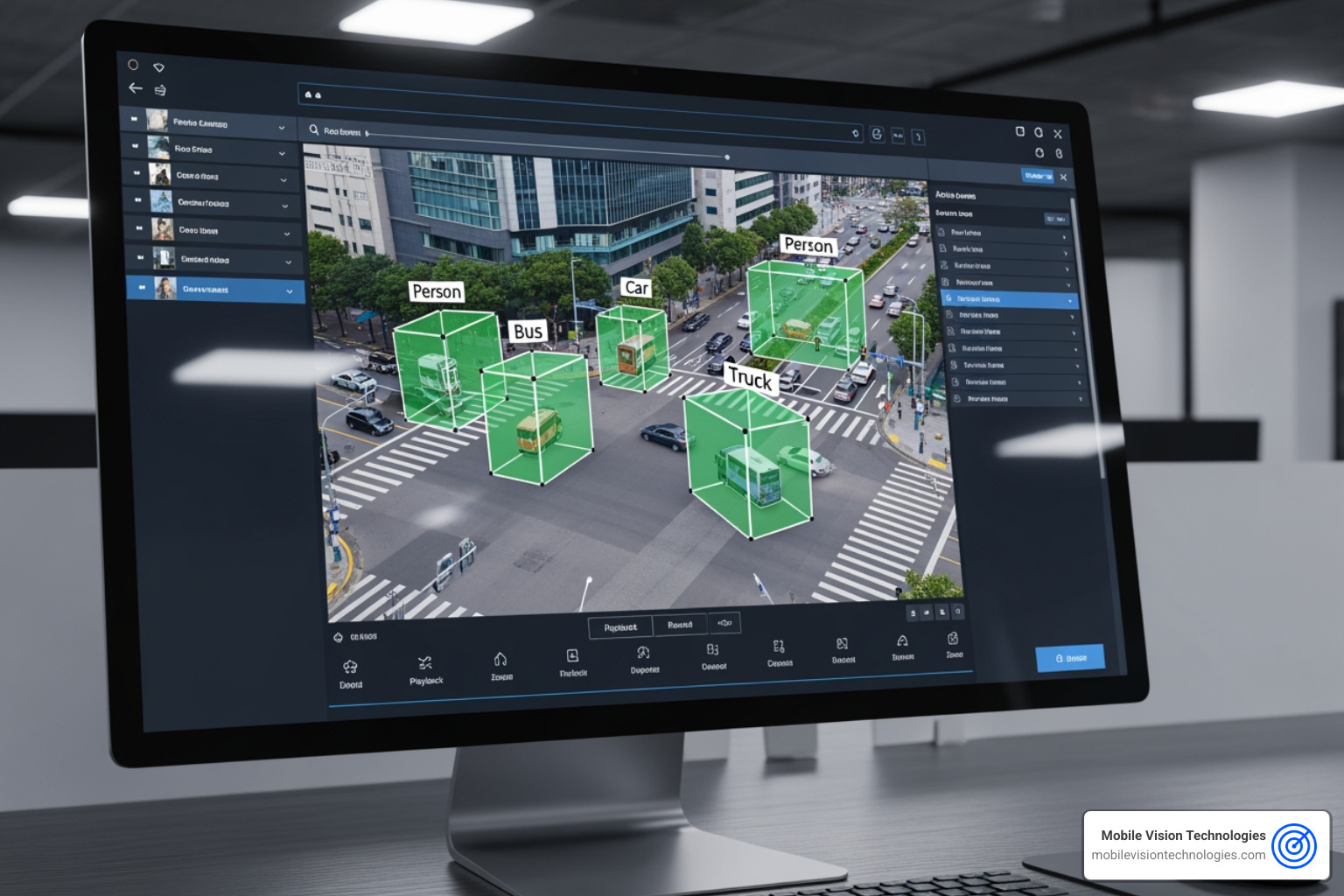
Now that our hardware is assembled and our software environment is ready, it’s time to infuse our ai surveillance system project with intelligence. This involves implementing the core AI capabilities that transform a simple camera into a smart monitoring solution.
Integrating Face Recognition and People Tracking
Face recognition can add a powerful layer of intelligence to our system. For example, in a small office or lab environment in Memphis, we could integrate face recognition for attendance tracking, automatically logging when known individuals enter or exit. This eliminates manual sign-ins and provides accurate records. The system can even prevent duplicate entries for the same person on the same day.
Beyond identification, we can implement sophisticated people movement monitoring systems. Using models like YOLOv8 for detection and ByteTrack or DeepSORT for multi-object tracking, our system can:
- Count entries and exits: Track the flow of people in and out of a specific area.
- Monitor social distancing: Detect if individuals are maintaining a safe distance, triggering alerts if a violation occurs (e.g., individuals are closer than 1.0 unit, which could represent feet or meters).
- Identify suspicious loitering: Flag individuals remaining in an area for an unusual amount of time.
These capabilities are invaluable for managing access and ensuring safety in various settings. For more advanced control over who can access what, our ai surveillance system project can be integrated with broader More info on Access Control Systems.
Key Applications for an AI Surveillance System Project
The versatility of an ai surveillance system project extends to numerous security scenarios:
- Identifying Non-Desired Items: Beyond people, AI can detect specific objects. Imagine a system in a warehouse in Southaven that flags unusual items left in restricted zones, or in a retail store in Jackson that identifies shoplifting attempts by recognizing items being concealed. The system can even be configured to exclude detecting people, focusing solely on other objects that shouldn’t be present.
- Suspicious Activity Detection: AI-powered cameras can learn typical human patterns (walking, moving, running) and detect deviations. If an activity deviates from the norm, it can trigger an alert. This could be someone attempting to tamper with equipment or engaging in an unusual behavior pattern.
- Fall Detection: In elderly care facilities or homes in Germantown, AI can detect falls, immediately alerting caregivers to potential emergencies.
- Parking Lot Monitoring: AI can manage parking spaces, detect unauthorized parking, or identify vehicles that have been in a lot for an extended period, which is particularly useful for businesses in Lakeland.
- Audio-Visual Fusion: For a truly comprehensive system, combining video analytics with audio detection can be powerful. SmartSurv, an advanced AI surveillance system, uses audio-visual fusion to detect alarming events like gunshots, screams, or breaking glass, providing a more holistic understanding of a situation.
These intelligent capabilities allow our system to move beyond passive recording to proactive detection and real-time intervention, significantly enhancing security. For more robust perimeter protection, consider integrating these features with advanced Alarm & Intrusion Detection systems.
Real-World Applications, Benefits, and Challenges
Our ai surveillance system project isn’t just a technical exercise; it has profound implications for public safety, operational efficiency, and cost savings across various industries. However, with great power comes great responsibility, especially concerning privacy and ethics.
AI surveillance systems significantly improve public safety by offering real-time threat detection and faster response times. They provide unparalleled flexibility and scalability, allowing us to deploy and adapt solutions to diverse environments, from temporary event monitoring in Bartlett to securing vast construction sites in Memphis. This flexibility often translates to cost savings by reducing the reliance on constant human oversight. For example, AI-powered monitoring can reduce the need for constant live-feed monitoring or additional guards, providing a cost-effective alternative as security guard wages continue to rise year-over-year.
The global AI surveillance camera market is booming, estimated at $5,490 million in 2022 and ready to reach $16,828 million by 2028. This growth is driven by widespread real-world applications:
- Retail: AI can deter theft, identify suspicious behavior, and even analyze customer traffic patterns to optimize store layouts. With retail theft being a persistent issue, this technology addresses a critical need for advanced security.
- Transportation: Monitoring for abandoned packages, unusual crowds, or unauthorized access in transportation hubs.
- Construction Sites: Highly valuable materials (copper wiring, lumber) and equipment make construction sites frequent targets for theft. Our Construction Site Surveillance Systems can deter and detect such activities, even in remote locations where traditional systems are not feasible.
- Elderly Care: AI provides crucial monitoring for falls or unusual behavior, ensuring timely assistance.
However, the rapid adoption of AI surveillance also brings significant challenges related to privacy, ethics, and data security.
Benefits Across Industries
The benefits of incorporating AI into our surveillance systems are clear and far-reaching:
- Improved Threat Detection: AI excels at identifying anomalies and potential threats that human operators might miss, such as a weapon being drawn or a person entering a restricted area.
- Reduced Workload for Personnel: By automating routine monitoring and flagging only critical events, AI frees up security personnel to focus on higher-level tasks and rapid response.
- Faster Response Times: Real-time AI analysis means alerts are generated instantly, allowing for immediate action, which is crucial in preventing incidents or mitigating damage.
- Predictive Analytics: AI can analyze historical data to predict potential security breaches, allowing for proactive measures.
- Reduced False Alarms: AI can differentiate between objects, animals, and humans, minimizing false positives from irrelevant movements (like a plastic bag blowing in the wind vs. an intruder).
These advantages translate into tangible improvements across various sectors. For instance, our Warehouse Security Systems leverage AI to monitor for unauthorized access, suspicious activity, and even workplace safety violations. Similarly, our Parking Lot Security Cameras use AI to detect parking violations, manage vehicle flow, and identify suspicious loitering, enhancing safety for customers and employees alike.
Navigating the Challenges
While the benefits are compelling, we must responsibly steer the challenges associated with an ai surveillance system project:
- Privacy Concerns: AI surveillance systems can capture extensive personal data, raising questions about data protection and individual privacy. We must ensure transparent data management practices and comply with relevant regulations.
- Ethical Dilemmas: The use of AI in surveillance raises ethical questions about bias in algorithms, the potential for misuse, and the impact on civil liberties. Developing and deploying these systems responsibly requires careful consideration of these ethical implications.
- Data Security and Integrity: Protecting the vast amounts of data collected by AI surveillance systems from cyber threats is paramount. Robust cybersecurity measures, including encryption and access controls, are essential to maintain data integrity and prevent breaches.
- Technical Challenges: Integrating AI with existing infrastructure, ensuring scalability, and continuously updating models to maintain accuracy can be technically complex.
To address these, the future of AI in security emphasizes Explainable AI (XAI), which aims to make AI decisions understandable and transparent. This helps build trust and allows for better auditing and accountability. Globally, around 75 out of 176 nations actively rely on AI-based surveillance cameras, according to the AIGS (Artificial Intelligence Global Surveillance) index, underscoring the widespread adoption and the imperative for responsible development.
Conclusion
Starting on an ai surveillance system project is a journey toward smarter, more proactive security. From selecting the right hardware like the Raspberry Pi 5 or NVIDIA Jetson, choosing efficient AI vision models, and carefully setting up the software environment with Python, OpenCV, and Docker, to even assembling custom 3D-printed enclosures; every step contributes to a robust and intelligent system.
We’ve explored how these projects can integrate advanced capabilities such as face recognition for attendance tracking, people movement monitoring for social distancing, and object detection for identifying non-desired items or suspicious activities. The benefits are clear: improved public safety, significant cost savings, and unparalleled flexibility across diverse industries, from retail to construction sites in Olive Branch.
However, we understand that with these powerful capabilities come critical responsibilities. Navigating privacy concerns, ethical dilemmas, and ensuring robust data security are paramount to the responsible deployment of AI surveillance. The future promises even deeper integration with IoT and the rise of Explainable AI, making these systems more transparent and trustworthy.
At Mobile Vision Technologies, we combine advanced IoT expertise with traditional security experience to provide flexible, full-service protection. Whether you’re building a DIY prototype or seeking a comprehensive commercial solution, the principles of an ai surveillance system project empower us to transform security from reactive to predictive.
To learn more about how we can help you implement cutting-edge intelligent monitoring, please Learn more about our AI-Powered Video Surveillance solutions.