
Intrusion Detection PPT 2026: Ultimate Guide
Why Understanding Intrusion Detection Matters for Your Security
An intrusion detection ppt needs to clearly explain how Intrusion Detection Systems (IDS) work as the digital watchdogs of your network, monitoring traffic and system activities to identify potential threats before they cause serious damage.
Quick Answer: Essential Elements for Your Intrusion Detection PPT
Your presentation should cover these core topics:
- What is IDS? – Define intrusion detection and its role as a network security sentinel
- IDS Types – Explain Network-Based (NIDS) and Host-Based (HIDS) systems
- Detection Methods – Cover signature-based and anomaly-based approaches
- IDS Architecture – Detail sensors, analysis engines, and alerting mechanisms
- Common Threats – Highlight attacks like DoS, malware, and unauthorized access
- IDS vs. IPS – Clarify the difference between detection and prevention systems
- Evaluation Metrics – Explain detection rates, false positives, and performance measures
- Future Trends – Discuss AI, machine learning, and evolving security challenges
Think of an IDS like a smoke detector for your computer network. It doesn’t put out the fire, but it alerts you the moment it detects danger, giving you precious time to respond. This early warning system is critical because cyber threats are growing more sophisticated every day, and traditional firewalls alone aren’t enough to protect your assets.
Whether you’re monitoring a construction site, a remote facility, or a temporary event space, understanding intrusion detection is essential for comprehensive security. The stakes are high – from protecting valuable equipment to safeguarding sensitive data and ensuring the safety of personnel on-site.
I’m Chris Edens, and I’ve spent years protecting people and assets, first in the army and now through advanced technology solutions. When creating an intrusion detection ppt, I focus on making these complex cybersecurity concepts accessible, because effective security starts with clear understanding.
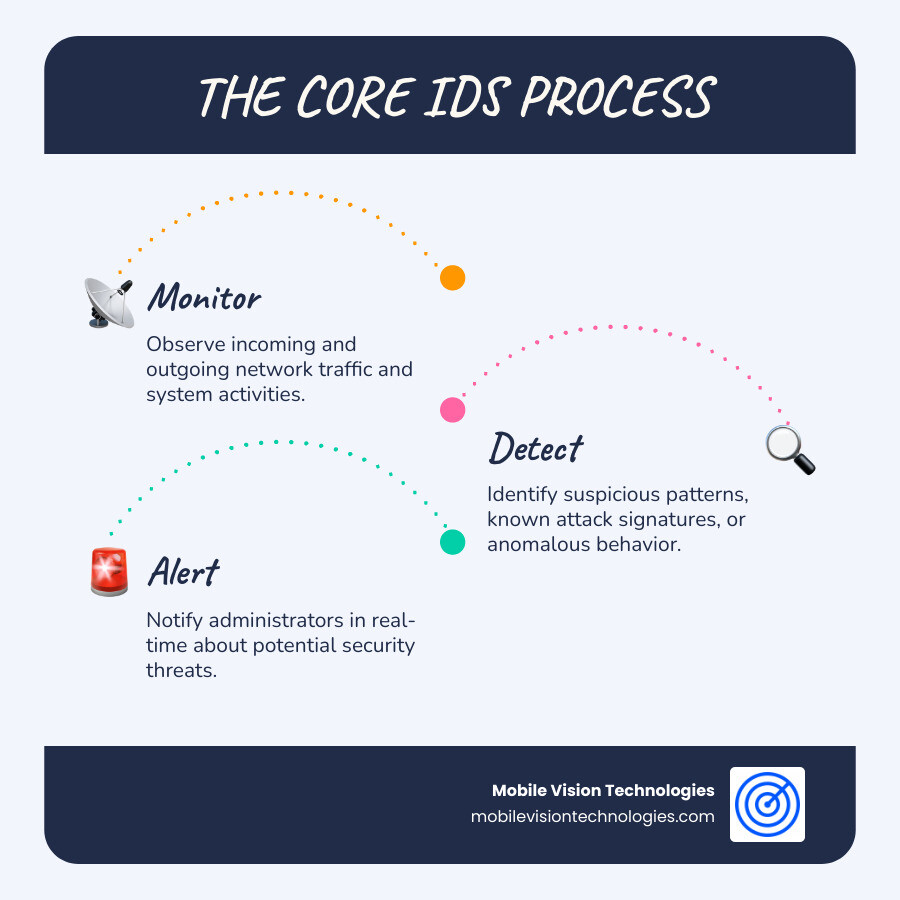
What is an Intrusion Detection System (IDS)? The Core Concepts
In an age where our digital lives and business operations are increasingly intertwined with technology, the need for robust security measures has never been more pressing. This is where Intrusion Detection Systems (IDS) step in, acting as the vigilant sentinels of our digital field.
At its core, an Intrusion Detection System is a security service that continuously monitors computer networks and systems for unauthorized access or activity. These digital watchdogs analyze incoming and outgoing traffic, system logs, and other data sources, looking for any signs that might indicate a security breach or malicious intent. We deploy them to protect our systems from threats that arise from increasing network connectivity and the constant flow of information.
Why is this so important? Because even with strong firewalls in place, threats can still slip through. Firewalls are like the bouncers at the front door, deciding who gets in and out based on predefined rules. An IDS, however, is like the security guard inside, constantly observing behavior to catch anyone who might have sneaked in, or someone legitimate acting suspiciously. This makes IDS a crucial component of a layered security strategy, offering critical threat visibility and enabling us to respond quickly to incidents.
Think of it as having an extra set of eyes, or even many sets of eyes, constantly scanning for anything out of the ordinary. This real-time monitoring capability is what makes IDS an indispensable tool in modern cybersecurity, complementing other security measures like firewalls and encryption to provide comprehensive protection. For us, ensuring the safety of properties and assets in Memphis, Jackson, and throughout the Mid-South means having these essential layers of security working in harmony.
More info about our security services
The Building Blocks: IDS Types and Detection Methods
To truly understand how an IDS works, especially if you’re putting together an intrusion detection ppt, grasp its various classifications and detection methodologies. Not all IDSs are created equal; they differ in where they operate and how they identify threats. These differences dictate their strengths, weaknesses, and ultimately, which type is best suited for specific security needs. Understanding these operational bases and detection techniques is key to building an effective system architecture and choosing the right IDS for your environment.
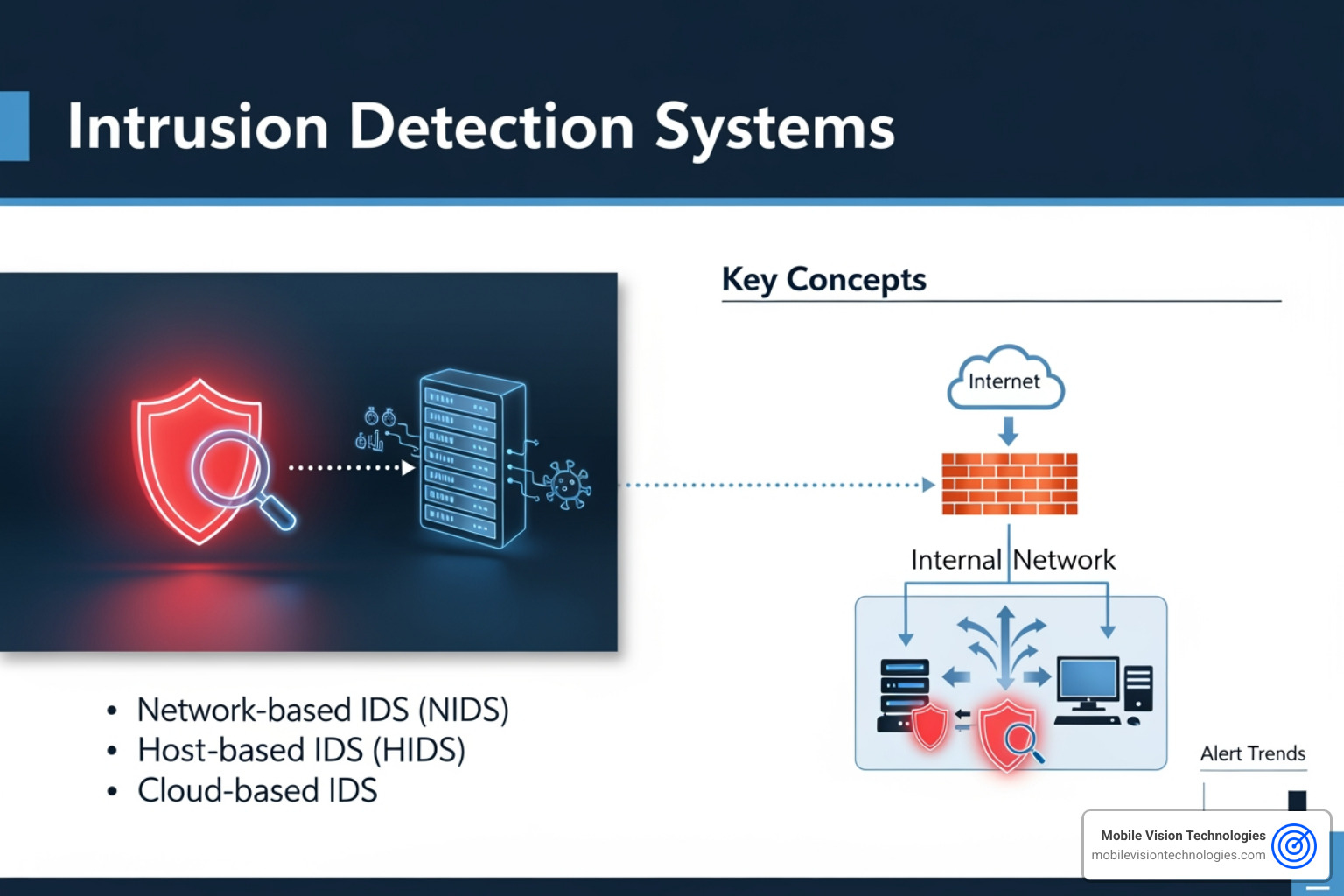
Network-Based (NIDS) vs. Host-Based (HIDS)
The first major distinction among IDS types is their operational scope:
- Network-Based Intrusion Detection Systems (NIDS): Imagine a NIDS as a traffic cop positioned at key intersections of your network, scrutinizing all passing vehicles (data packets). NIDS monitors traffic on the network by examining packets as they pass by a sensor, often operating in what’s called “promiscuous mode.” This allows it to see all traffic, not just traffic addressed to it. NIDS are excellent for monitoring multiple devices across a network segment and are operating system independent.
- NIDS Strengths: They offer a reduced cost of ownership per monitored host, provide extensive packet analysis, can detect malicious intent, and are generally operating system independent. They also allow for real-time detection and response across a broad area.
- NIDS Weaknesses: A significant challenge for NIDS is encrypted traffic. Since it cannot analyze encrypted packets, attacks can be defeated by encryption. NIDS can also be overwhelmed by high network volume, potentially missing threats, and may have limited application-level semantic information.
- Host-Based Intrusion Detection Systems (HIDS): In contrast, a HIDS is like a personal bodyguard assigned to an individual, critical server or endpoint. It focuses on individual hosts or endpoints like servers or personal computers. HIDS works by intercepting operating system and application calls, checking the integrity of system files, and watching for suspicious processes. It analyzes logs and audit information from the host operating system or application to detect trails of intrusion.
- HIDS Strengths: HIDS offers the most comprehensive program information for detection, making it highly accurate for the specific host it protects. It excels at attack verification, system-specific activity monitoring, and can even operate effectively in encrypted and switched environments by monitoring activity after decryption. They provide near real-time detection and response without requiring additional hardware beyond the host itself.
- HIDS Weaknesses: A major drawback is that HIDS can be tampered with if the attacker takes over the machine. They require installation on all machines you wish to monitor, which can be resource-intensive, and they only provide a local view of attacks, meaning they don’t see what’s happening elsewhere on the network.
Both NIDS and HIDS play crucial roles, and often, the most robust security posture involves deploying them together to cover both network-wide and host-specific threats.
Signature-Based vs. Anomaly-Based Detection
Beyond their deployment location, IDSs are also categorized by how they detect intrusions:
- Signature-Based Detection (Misuse Detection): This method is akin to a detective looking for known fingerprints at a crime scene. Signature-based IDS possesses an attack description (a “signature”) that can be matched to sensed attack manifestations. It looks for attack signatures, which are specific patterns that usually indicate malicious or suspicious intent. Early detection methods relied heavily on these techniques, essentially looking for known patterns associated with specific attacks.
- Advantages: Signature-based detection is mostly accurate against known threats because it’s looking for very specific, predefined patterns.
- Disadvantages: Its primary weakness is its inability to detect new, unknown attacks (often called “zero-day” attacks). It requires constant updates to its signature database, suffers from false alarms if signatures are too broad, and has to be reprogrammed for every new pattern.
- Anomaly-Based Detection (Statistical-Based Detection): This approach is more like a behavioral psychologist. Instead of looking for known bad behavior, it first establishes a “normal usage” baseline for the network or system. Anything distinct from this established normal behavior is then assumed to be an intrusion activity. This method models the normal usage of the network as a noise characterization. As cybercriminals became more sophisticated, there was a shift towards anomaly detection models that could identify unusual behavior even if it didn’t match any existing signatures.
- Advantages: Anomaly detection can detect potential new attacks, including zero-days, because it doesn’t rely on pre-existing knowledge of attack patterns. It recognizes novel attacks by identifying deviations from the norm.
- Disadvantages: The main challenge is its relatively high false positive rates. Since it flags anything unusual, legitimate but uncommon activities can trigger alarms, potentially leading to “alert fatigue” among IT teams. It assumes intrusions will have manifestations distinct enough to permit detection.
Here’s a quick comparison:
| Feature | Signature-Based IDS | Anomaly-Based IDS |
|---|---|---|
| Detection Method | Matches known attack patterns (signatures). | Detects deviations from established “normal” behavior. |
| Pros | Highly accurate for known threats; lower false negatives for recognized attacks. | Can detect novel/zero-day attacks; adaptable to evolving threats. |
| Cons | Cannot detect unknown attacks; requires constant signature updates; can have false alarms. | Higher false positive rates; requires a learning period to establish baseline; assumes intrusions are “abnormal.” |
| Best Use Cases | Protecting against widespread, well-documented attacks (e.g., specific malware strains). | Identifying sophisticated, never-before-seen threats and insider attacks. |
Crafting Your Intrusion Detection PPT: Key Topics to Include
When we prepare an intrusion detection ppt, our goal is always to explain these complex topics clearly and concisely. A well-structured presentation ensures your audience grasps the essentials, from how these systems are built to the threats they combat and how they fit into a broader security strategy.
Key Components and Architecture
An effective IDS isn’t just a single piece of software; it’s a sophisticated system with several interconnected components working in concert. When outlining IDS architecture in your intrusion detection ppt, we typically highlight:
- Sensors: These are the data collectors. For NIDS, sensors are placed at strategic network points (like behind firewalls or on major backbones) to capture traffic. For HIDS, they’re agents installed on individual hosts, gathering system logs, file changes, and process activities.
- Analysis Engine: This is the brain of the IDS. It processes the raw data collected by the sensors, applying detection methodologies (signature-based or anomaly-based) to identify suspicious activities.
- Knowledge Base / Signature Database: This component stores the known attack signatures for signature-based detection or the baseline “normal” profiles for anomaly-based detection. It needs constant updates to remain effective.
- User Interface (Console): This is where security administrators interact with the IDS, configure rules, view alerts, and manage the system.
- Alerting Mechanism: When an intrusion is detected, the IDS needs to notify administrators. This can be via emails, pagers, or integration with Security Information and Event Management (SIEM) systems.
- Response Model: While an IDS primarily detects, it often has a response model. This can range from passive (just generating an alert) to more active (e.g., dropping suspicious packets, blocking an IP address, or even integrating with an Intrusion Prevention System for automated blocking).
Common Intrusion Techniques to Highlight in Your Intrusion Detection PPT
To fully appreciate the role of an IDS, it’s crucial to understand what kind of attacks it’s designed to detect. Here are some common intrusion techniques we often discuss:
- Malware (Viruses & Worms): These are malicious software designed to disrupt, damage, or gain unauthorized access to computer systems. Viruses require a host program, while worms are self-replicating and spread independently across networks.
- Denial of Service (DoS) Attacks: These attacks aim to make a service unavailable by overwhelming it with a flood of traffic, often by flooding a host with lots of packets. Distributed Denial of Service (DDoS) attacks use multiple compromised systems to launch the attack.
- Network Scanning & Port Scans: Attackers use tools to probe networks and systems, identifying open ports and vulnerable services. This “footprinting” helps them understand the network’s layout and potential entry points.
- Buffer Overflows: A common vulnerability where a program attempts to write data beyond the allocated buffer, potentially overwriting adjacent memory and executing malicious code.
- Password Cracking: Attempts to find passwords through brute-force methods (trying many combinations) or dictionary attacks (using common words).
- Phishing Attacks: Social engineering tactics designed to trick users into revealing sensitive information, often leading to unauthorized access.
- Insider Threats: These are attacks originating from within an organization by trusted individuals. Insider attacks are among the most difficult to detect and prevent due to employees’ legitimate access and system knowledge.
IDS vs. IPS: Explaining the Critical Difference in Your Intrusion Detection PPT
One of the most important distinctions to make in any intrusion detection ppt is the difference between an Intrusion Detection System (IDS) and an Intrusion Prevention System (IPS). While often discussed together, their core functions are distinct:
- Intrusion Detection System (IDS): As we’ve discussed, an IDS is primarily a monitoring and alerting tool. It detects suspicious activity and notifies administrators. Think of it as a sophisticated alarm system. It observes, analyzes, and alerts, allowing human intervention to stop the threat. Its deployment is often out-of-band, meaning it doesn’t directly interfere with network traffic unless configured for a passive response.
- Intrusion Prevention System (IPS): An IPS takes the capabilities of an IDS a step further by actively preventing detected intrusions. It not only identifies malicious activity but also takes real-time action to block the attack. This usually involves dropping malicious packets, resetting connections, or blocking traffic from suspicious IP addresses. An IPS typically operates in-line with network traffic, acting as a gatekeeper that can prevent attacks before they reach their target. In fact, research indicates that IPS can prevent attacks by 15% and increase visibility by 10%. While intrusion detection is important, intrusion prevention systems that can block attacks in real-time are increasingly replacing detection-only systems.
The simplest way to remember the difference? An IDS detects and alerts, while an IPS detects and prevents. For comprehensive security, especially in dynamic environments like those we secure for our clients across Tennessee and Mississippi, both detection and prevention capabilities are often integrated into a unified system.
Learn more from this Intrusion Detection/Prevention Systems presentation
The Evolution and Future of Intrusion Detection
The landscape of cyber threats is constantly shifting, making intrusion detection a field of continuous innovation. Modern challenges, such as the sheer volume of data, the rise of sophisticated polymorphic malware, and the increasing reliance on encrypted communications, demand that IDS technologies evolve rapidly. This evolution is heavily influenced by advancements in artificial intelligence and machine learning, pointing towards a future where intrusion detection is more proactive, adaptive, and integrated than ever before.

The Role of AI and Machine Learning in Modern IDS
The advent of AI and machine learning has profoundly impacted the effectiveness and future direction of Intrusion Detection Systems. These technologies are revolutionizing how we detect and respond to cyber threats:
- Faster and More Accurate Detection: AI-driven solutions are making intrusion detection faster and more accurate than ever before. Machine learning algorithms can process vast amounts of data at speeds impossible for human analysts, identifying subtle patterns that indicate malicious activity.
- Predictive Analysis: One of the most exciting aspects is AI’s ability to learn from past incidents to predict future threats. By analyzing historical attack data and network behavior, AI models can anticipate potential vulnerabilities and emerging attack vectors.
- Reduced False Positives: While anomaly-based detection traditionally struggles with high false positive rates, AI and machine learning are helping to refine these models. They can learn to distinguish between truly anomalous malicious behavior and benign, unusual activity, significantly reducing alert fatigue among IT teams.
- Behavioral Analysis: AI excels at establishing and continuously updating baselines of “normal” behavior for users, applications, and network devices. Any deviation from these learned patterns can be flagged as a potential intrusion, making it effective against novel attacks that lack traditional signatures.
- Data Mining: Data mining techniques are increasingly applied to intrusion detection to alleviate the limitations of traditional signature-based systems, enabling the findy of new attack patterns within large datasets.
For us at Mobile Vision Technologies, AI is not just a buzzword; it’s integrated into solutions like our AI-Powered Video Surveillance, which uses intelligent algorithms to improve situational awareness and threat detection in physical environments, mirroring the advancements in network security.
Overcoming Challenges and Evaluating IDS Performance
Despite the advancements, implementing and managing an IDS comes with its own set of challenges, which any good intrusion detection ppt should address:
- False Positives: This remains a significant hurdle. Imagine receiving countless alerts about potential breaches only to find they were harmless fluctuations in normal user behavior. This can lead to alert fatigue among IT teams, causing genuine threats to be overlooked.
- Encrypted Traffic: As more and more network traffic becomes encrypted, NIDS face difficulties inspecting the content of packets, potentially allowing threats to pass undetected.
- Scalability Issues: Deploying and managing IDS across large, complex networks, especially those with numerous endpoints like those found in commercial properties or construction sites, can be challenging and resource-intensive.
- Evaluation Metrics: To assess the effectiveness of an IDS, we rely on key metrics:
- Detection Rate (True Positives): The percentage of actual attacks that the IDS successfully identifies. Calculated as (True Positives / (True Positives + False Negatives)) * 100%.
- False Alarm Rate (False Positives): The percentage of legitimate activities that the IDS incorrectly flags as attacks. Calculated as (False Positives / (False Positives + True Negatives)) * 100%.
- ROC Curves: Receiver Operating Characteristic (ROC) curves are often used to visualize the trade-off between the detection rate and the false alarm rate, helping to fine-tune IDS thresholds for optimal performance.
- System Performance: The IDS itself must be able to process network traffic and system data without causing significant latency or consuming excessive resources.
The Future of IDS: What’s Next?
The future of Intrusion Detection Systems is dynamic and promising, continuously adapting to the evolving threat landscape:
- Hybrid IDS Solutions: We’re seeing a stronger move towards integrating network and host-based IDS for better detection. Combining the broad visibility of NIDS with the deep insight of HIDS provides a more comprehensive security posture.
- Cloud-Based IDS: With the increasing adoption of cloud computing, IDS solutions are shifting to protect cloud environments, offering scalability and flexibility for monitoring virtualized infrastructures.
- IoT Security: The proliferation of IoT devices, from mobile surveillance cameras to smart sensors, presents new attack surfaces. Future IDS will be critical in monitoring and securing these diverse, often resource-constrained, devices.
- Integration with SIEM and SOAR: IDS will become even more tightly integrated with Security Information and Event Management (SIEM) systems for centralized logging and correlation, and with Security Orchestration, Automation, and Response (SOAR) platforms for automated incident response workflows.
- Vulnerability-Based Detection: Next-generation IDSs are moving towards vulnerability-based detection, where they understand system weaknesses and look for attempts to exploit those specific vulnerabilities, rather than just known attack signatures.
The ongoing development of IDS schemes for detecting novel attacks, coupled with advanced analytics, will ensure that these systems remain a critical line of defense in our collective effort to secure digital assets and physical properties.
Explore future trends in this Intrusion Detection Presentation
Conclusion
As we’ve explored, Intrusion Detection Systems are far more than just a piece of software; they are a critical layer in any robust cybersecurity strategy. From their fundamental role as digital sentinels to the nuanced differences between NIDS and HIDS, and the sophisticated methods of signature-based versus anomaly-based detection, understanding IDS is paramount. We’ve seen how AI and machine learning are propelling these systems into a future of faster, more accurate, and more proactive threat detection, even as we steer challenges like false positives and encrypted traffic.
For us at Mobile Vision Technologies, this deep understanding of intrusion detection is foundational to the intelligent mobile surveillance solutions we provide. Whether it’s securing a construction site from theft in Memphis or monitoring a remote facility in Jackson, our goal is always to deliver comprehensive protection. We integrate advanced IoT expertise with traditional security experience, ensuring that our systems not only detect potential threats but also provide the actionable intelligence needed to respond effectively.
When digital and physical security are increasingly intertwined, having a vigilant IDS in place means we can proactively safeguard valuable assets, ensure customer safety, and maintain peace of mind. It’s about being prepared, being aware, and being protected.
Secure your assets with advanced Alarm & Intrusion Detection solutions