
AI Video Surveillance in 2026: What the Market Data Shows and the Privacy Debate Nobody’s Skipping
The AI in Video Surveillance Market is Changing Security Right Now
AI-powered video surveillance has moved from a niche upgrade to a mainstream expectation faster than almost any other security technology in the last decade. That growth is real and measurable — but it’s arriving alongside a genuine, unresolved debate about how much monitoring is appropriate, who gets to decide, and what happens when the technology gets it wrong. Both conversations matter, and neither one is complete without the other.
I’m Chris Edens. I’ve spent my career on the physical security side of this industry, deploying the cameras this article is about — which puts me in an odd position: I make my living selling the technology, and I still think the privacy questions deserve a straight answer, not a sales pitch. Here’s both sides.
The Market Reality: How Big Is This, Actually?
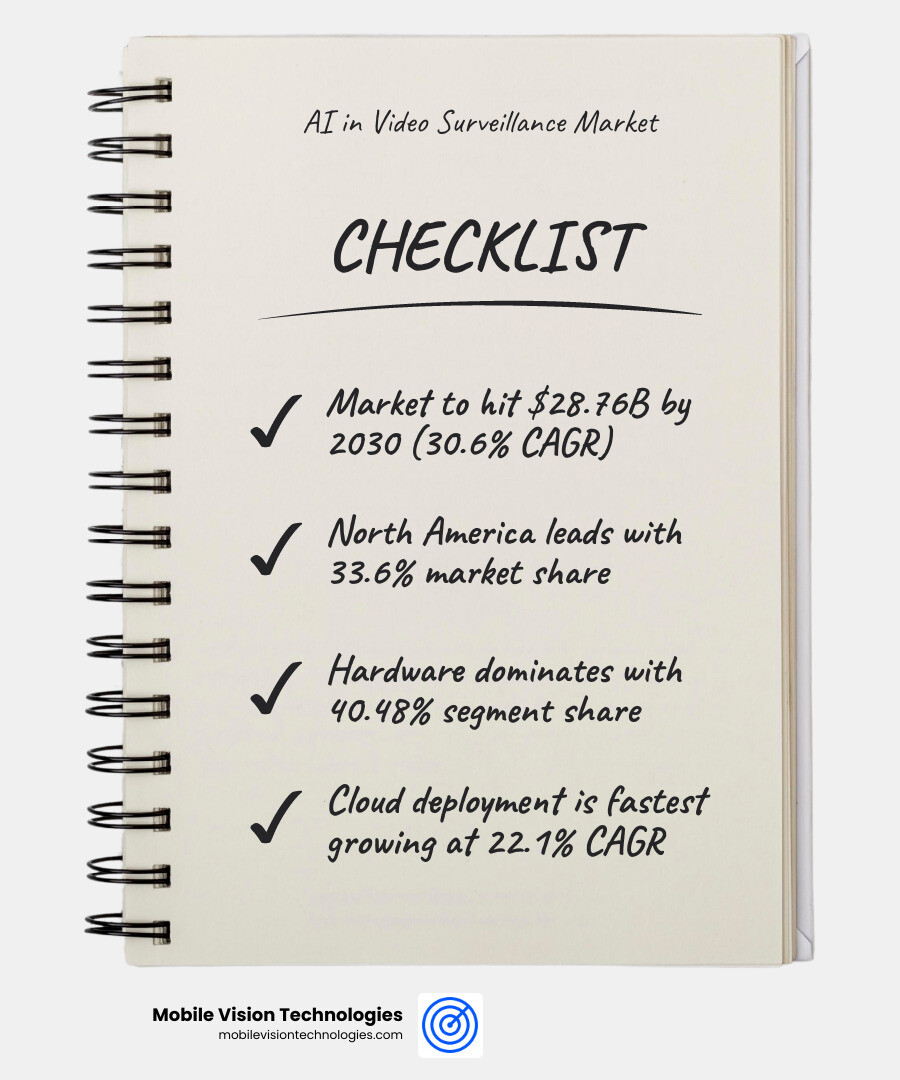
The AI video surveillance market was valued at roughly $6.51 billion in 2024 and is projected to reach $28.76 billion by 2030 — a compound annual growth rate of about 30.6%, according to Grand View Research’s industry analysis. A few numbers behind that headline figure:
| Metric | 2024/2025 | Trend |
|---|---|---|
| North America market share | 33.6% | Largest regional market |
| Hardware share of revenue | 40.48% (2024) | Cameras, sensors, edge devices |
| Software growth rate | 17.85% CAGR | Fastest-growing segment |
| On-premises deployment share | 64.35% (2025) | Still dominant, but shrinking |
| Cloud deployment growth | 22.1% CAGR | Outpacing on-premises |
| Commercial sector share | 43.05% of market | Largest end-use category |
| Large-enterprise AI adoption | 65%+ | Already using AI video analytics |
The practical takeaway from these numbers: this isn’t an emerging technology anymore in the way it was five years ago. It’s a maturing market where the hardware is commoditizing, the software layer is where the growth is concentrating, and the shift toward cloud deployment is happening but hasn’t overtaken on-premises systems yet — which matters if you’re deciding what to invest in and when.
Adoption isn’t just growing in raw numbers — the accuracy of the systems is what’s driving it. Detection accuracy in modern systems has improved by an estimated 40-50% over legacy motion-based systems, and false alarm rates have dropped by 35% or more in properly configured deployments. That’s the difference between a system that’s genuinely useful and one that trains everyone to ignore its alerts.

Where the Growth Is Coming From
Regulation is playing a bigger role in this market than people expect. The EU’s AI Act — the first comprehensive AI regulatory framework from a major economic bloc — is already shaping how vendors build compliance and transparency features into their products, even outside Europe, the same way GDPR ended up influencing U.S. data practices well beyond its borders.
Locally, we’ve watched this play out directly: Memphis has invested in a citywide camera network and command center as part of a broader public-safety initiative, one of a growing number of municipalities treating AI-assisted video monitoring as core infrastructure rather than a specialty tool. That kind of public-sector adoption tends to normalize the technology for commercial buyers too — when the city down the street is running an AI-monitored camera network, “should we have AI-powered cameras at our facility” stops being a hypothetical question for a lot of businesses.

The Trade-Off Nobody’s Skipping: Privacy and Oversight
None of the growth above happens in a vacuum. Every one of these deployments raises the same underlying question: how much monitoring is appropriate, and who’s accountable when the system gets it wrong?
| Benefits | Risks |
|---|---|
| Faster threat detection — weapon identification in under a second in leading systems | Facial recognition misidentification rates that are measurably worse for some demographic groups |
| Reduced false alarms, freeing up human attention for real events | Function creep — systems deployed for one purpose (safety) get repurposed for another (tracking, profiling) |
| 24/7 coverage without fatigue or blind spots | No comprehensive federal privacy law governing video/biometric data in most of the U.S. |
| Forensic search — finding a specific person or vehicle in hours of footage in seconds | Workplace surveillance with little disclosure requirement in many states |
| Deterrence effect that can prevent incidents before they happen | Data retention practices that often outlast any real business justification |
| Faster, more consistent emergency response | Vendor and government access to footage without clear public accountability |
| Scalable coverage of large areas without proportional staffing increases | Public unease — a system built for safety can still feel like surveillance for its own sake |
| Objective, timestamped documentation for incidents and investigations | Difficulty auditing “black box” AI decisions after the fact |
That last risk — auditability — is where a lot of the current policy debate is actually focused. Illinois’ Biometric Information Privacy Act (BIPA) has already resulted in real litigation over how companies collect and store biometric identifiers, and a federal-level proposal, the Algorithmic Accountability Act, would require companies to assess and report on the impact of automated decision systems, including surveillance analytics. Whether or not that specific bill passes, the direction is clear: regulators are moving toward requiring more transparency about what these systems do and how they’re audited, not less.
What Responsible Deployment Actually Looks Like
For a business or municipality deciding to adopt AI-powered surveillance, the practical version of “doing this responsibly” comes down to a few concrete things:
- Scope the system to a stated purpose — and don’t quietly expand its use later without revisiting whether that’s still appropriate.
- Know your state’s consent and notification requirements before deploying anything with audio capture or biometric analysis — these vary significantly and change often.
- Set a real data retention policy, not a default. Footage that has no ongoing investigative or business purpose is a liability sitting on a server, not an asset.
- Keep a human in the loop for any decision with real consequences — an AI alert should trigger human review, not automatic action, for anything beyond routine motion-based notifications.
- Ask your vendor how their system handles edge cases — lighting conditions, demographic accuracy variance, and false-positive rates aren’t marketing footnotes, they’re operational risk.
Where This Leaves Buying Decisions
If you’re evaluating AI-powered cameras for your property, the market data above should tell you the technology is mature enough to trust, and the privacy considerations should tell you it’s worth choosing a vendor who treats those questions seriously rather than glossing over them. For the practical side of what these systems can actually do and how to evaluate one for your industry, see our guide to AI-powered video surveillance systems and our buyer’s guide to AI security cameras.
Our own AI-powered video surveillance systems are built on mobile, solar-powered trailers rather than permanent fixed infrastructure — which has a practical side benefit for exactly this conversation: coverage that deploys for the duration of an actual need (a construction project, an event, a temporary risk period) rather than defaulting to permanent, indefinite monitoring. It’s paired with our alarm & intrusion detection and access control systems, and available with full installation, maintenance & monitoring support if you’d rather not manage it yourself.
Talk to Us About What Fits Your Property
Whether you’re weighing the market data, the privacy questions, or both, we’re glad to walk through what a responsible AI-powered deployment looks like for your specific site. Request a free quote and we’ll assess your property and talk through what’s actually appropriate for your situation — not just what we can sell you.